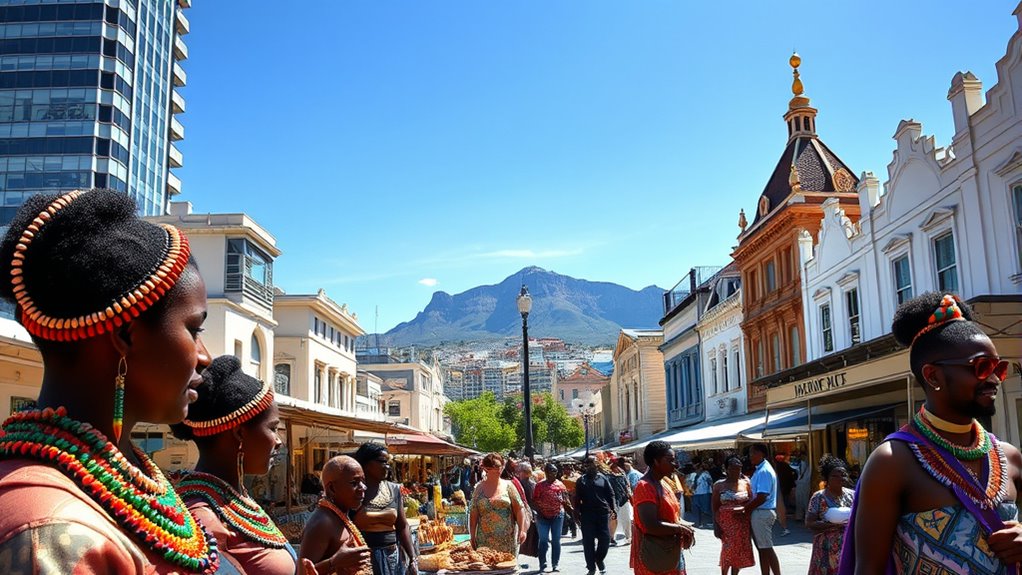

South Africa’s history begins with ancient human origins and early inhabitants like the San and Khoikhoi, followed by Bantu migrations that shaped societies with rich traditions. European colonization brought conflicts and the establishment of racial policies, culminating in apartheid, which enforced segregation and resisted by resilient activists like Nelson Mandela. Today, South Africa is a vibrant, multicultural nation still facing challenges, but its diverse culture and history remain deeply inspiring—if you explore further, you’ll uncover even more.
Key Takeaways
- South Africa has a rich history with ancient human fossils and early indigenous cultures like the San and Khoikhoi.
- The region experienced European colonization, notably by the Dutch and British, leading to conflicts and the formation of Boer republics.
- Apartheid-era laws enforced racial segregation, resisted by movements like the ANC, culminating in a democratic transition in 1994.
- The country celebrates its multicultural identity through diverse languages, festivals, music, dance, and traditional arts.
- Contemporary South Africa faces challenges such as inequality, unemployment, and political corruption, impacting social cohesion and progress.

30 Pack 4 Inch Wood Africa Cutouts Unfinished Wood Africa Crafts Wooden Africa Hanging Ornaments DIY Africa Craft Gift Tags for Home Party Decoration
Unfinished wooden Africa cutouts are made of quality wood for durable use; with smooth surface, easy to paint…
As an affiliate, we earn on qualifying purchases.
As an affiliate, we earn on qualifying purchases.
Origins and Early Inhabitants of South Africa

South Africa’s history begins long before European contact, with some of the world’s oldest human fossils discovered in the region. You can trace the origins of humankind here, where early hominids and Homo sapiens thrived thousands of years ago. The San (Bushmen) and Khoikhoi (Khoisan) peoples are the original inhabitants, living as hunter-gatherers and pastoralists. They developed rich cultural traditions and social structures, adapting to the diverse landscapes. Around 200 AD, Bantu-speaking peoples migrated southward, bringing agriculture and ironworking, which transformed local societies. These early communities laid the foundation for complex societies, trade networks, and kingdoms that would later shape South Africa’s history. Their resilience and innovations are central to understanding the region’s deep-rooted cultural and historical identity, especially considering the early human migration that took place across Africa.

The Mbira: An African Musical Tradition
As an affiliate, we earn on qualifying purchases.
As an affiliate, we earn on qualifying purchases.
The Arrival of Bantu Peoples and Kingdoms
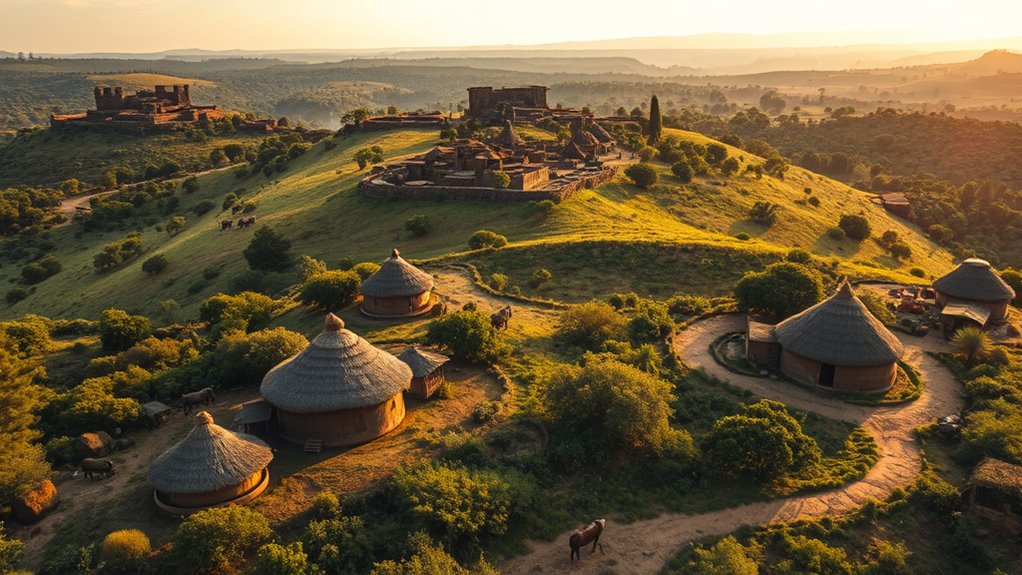
Around 200 AD, Bantu-speaking peoples began migrating into the region, considerably transforming the local societies. You see, they brought new skills like farming, ironworking, and social organization. Over time, they established powerful kingdoms and communities, shaping the cultural landscape. To understand their influence better, look at this table:
| Aspect | Bantu Contributions |
|---|---|
| Agriculture | Cultivated millet, sorghum, yams |
| Iron Technology | Advanced tools and weapons |
| Social Structure | Chiefs, clans, and lineage systems |
| Cultural Traditions | Music, dance, and oral storytelling |
These communities thrived, creating complex societies that laid the foundation for future states and cultural development in South Africa. Their migration patterns significantly impacted the demographic and cultural makeup of the region.
A History of South Africa, Fourth Edition
As an affiliate, we earn on qualifying purchases.
As an affiliate, we earn on qualifying purchases.
European Colonial Encounters and Conflicts
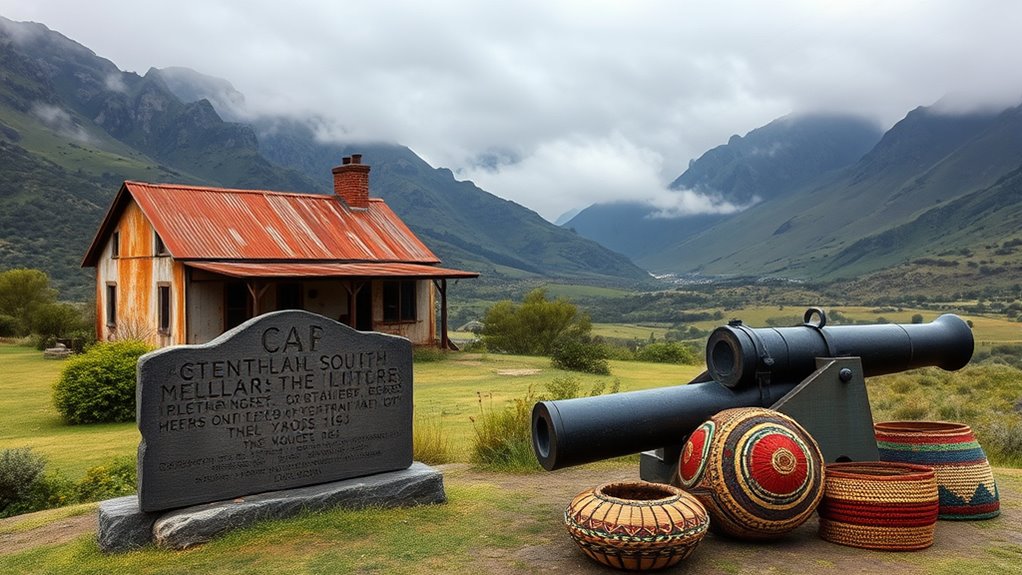
European powers began arriving in the region in the 17th century, establishing trading posts and claiming territories through colonization. The Dutch East India Company founded Cape Town in 1652 as a supply station, marking the start of European influence. Over time, conflicts arose as the Dutch expanded inland, clashing with indigenous groups like the San and Khoikhoi. In the late 18th century, the British took control during the Napoleonic Wars, intensifying rivalry with the Dutch settlers, known as Boers. The Boers resisted British rule, leading to the Great Trek and the creation of independent Boer republics. Tensions escalated with conflicts such as the Anglo-Zulu War in 1879. These encounters fueled resistance, shaped territorial boundaries, and laid the groundwork for future racial and political struggles in South Africa. Additionally, the presence of Native cultures significantly influenced the region’s social and cultural development.

Zhlichouy African Jewelry Sets for Women Boho Tribal Retro Statement Choker Necklace and Dainty Dangle Earring Set Multicolor Ethnic Style Chunky Bib Collar Costume Jewelry Accessories for Women
African Jewelry Sets for Women:Zhlichouy gold plated ethnic style jewelry sets for women with fashion exquisite design,Integrating elements…
As an affiliate, we earn on qualifying purchases.
As an affiliate, we earn on qualifying purchases.
The Formation of the Union and Early Racial Policies

In 1910, the Union of South Africa was established, uniting the Cape Colony, Natal, Transvaal, and Orange Free State under a single government. You quickly realize that this political union was built on racial exclusions. White settlers reserved voting rights for males, while Black majority populations were disenfranchised. The 1913 Native Land Act restricted Black land ownership to just 7%, cementing racial inequalities. The Afrikaner Broederbond, founded in 1918, began shaping policies rooted in racial segregation. To illustrate, consider the following:
| Policy/Impact | Description |
|---|---|
| Disenfranchisement | Black populations denied voting rights |
| Land Restrictions | Limited Black land ownership |
| Racial Segregation | Early laws segregated races |
| Political Suppression | Black political movements weakened |
| Foundation for Apartheid | Racial policies laid groundwork for later laws |
Additionally, these racial policies laid the foundation for the formal apartheid system that would be implemented decades later.
The Rise of Apartheid and Its Impact

You witness how apartheid institutionalized racial segregation, creating deep societal divisions. Resistance grew through protests and activism, but harsh repression marked many struggles. As tensions escalated, the country’s social fabric became increasingly fractured, shaping its future challenges.
Institutionalization of Segregation
The rise of apartheid marked a deliberate and systematic effort to institutionalize racial segregation in South Africa, deeply embedding discrimination into every aspect of society. Laws like the 1950 Population Registration Act classified people by race, creating a rigid racial hierarchy. The 1953 Bantu Education Act deliberately downgraded black education, reinforcing inequality. The 1959 Reservation of Separate Amenities Act mandated separate facilities, legitimizing segregation in public spaces. The Group Areas Act of 1950 forcibly removed non-white communities from their homes to designated racial zones. These laws stripped rights, limited mobility, and segregated neighborhoods, schools, and workplaces. You would find yourself living, working, and accessing services based solely on your racial classification, with privileges for whites and restrictions for others. This system aimed to maintain white dominance and oppress racial minorities.
Resistance and Repression
How did South Africans respond to the brutal realities of apartheid’s rise? You saw resistance emerge through protests, strikes, and underground activism. The African National Congress (ANC) and other groups organized against racial laws, risking arrest and violence. You witnessed acts of defiance like the Defiance Campaign of 1952 and the Freedom Charter of 1955, calling for equality. Repression was severe: police used violence against protesters, and many activists faced imprisonment, exile, or death. The Sharpeville Massacre of 1960 marked a turning point, galvanizing international outrage. Despite brutal crackdowns, resistance persisted, including sabotage campaigns and the rise of armed groups like Umkhonto we Sizwe. You saw hope amid repression, fueling the fight for justice and equality that would transform the nation.
Societal Divisions Deepen
As resistance grew against apartheid’s oppressive policies, the South African government responded by intensifying racial divisions to maintain control. You see, they passed laws that strictly separated people based on race, deepening social gaps. This caused lasting impacts:
- Segregated living areas forced non-white populations into specific neighborhoods, creating economic and social barriers.
- Limited black land ownership kept black South Africans impoverished and dependent on white-controlled farms.
- Education disparities left non-white communities with inferior schooling, hindering opportunities.
- Political repression silenced resistance, making it harder for communities to unite and challenge the system.
These measures not only reinforced inequality but also fostered resentment, fueling ongoing struggles for justice and equality. The divisions, once deepened, shaped South Africa’s future for decades.
The Fight for Freedom and Transition to Democracy
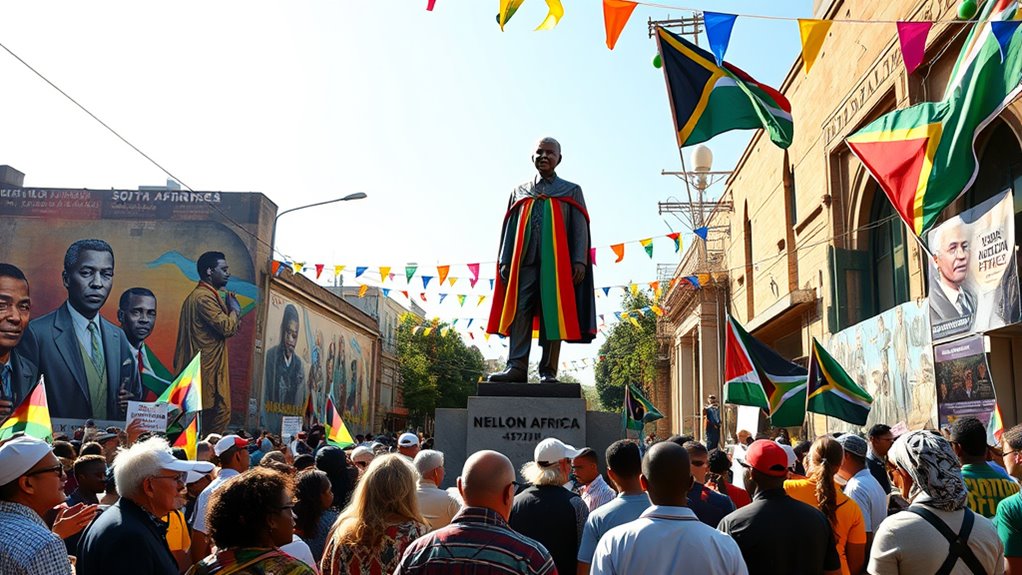
South Africa’s journey toward democracy was marked by decades of relentless struggle against racial oppression and systemic injustice. You witnessed fierce resistance from groups like the African National Congress (ANC) and leaders such as Nelson Mandela, who spent 27 years imprisoned fighting apartheid. The 1980s saw escalating protests, strikes, and international sanctions that pressured the government to change. In 1990, F.W. de Klerk unbanned liberation movements and released Mandela, opening the door for negotiations. These efforts culminated in South Africa’s first democratic elections in 1994, where all races could vote freely. Nelson Mandela’s presidency symbolized unity and hope. This progression was a monumental victory for justice, ending institutionalized racial segregation and setting South Africa on a path toward equality and reconciliation. Sound therapy and other holistic approaches have been explored to promote healing and unity in post-apartheid South Africa.
Building a Multicultural Society
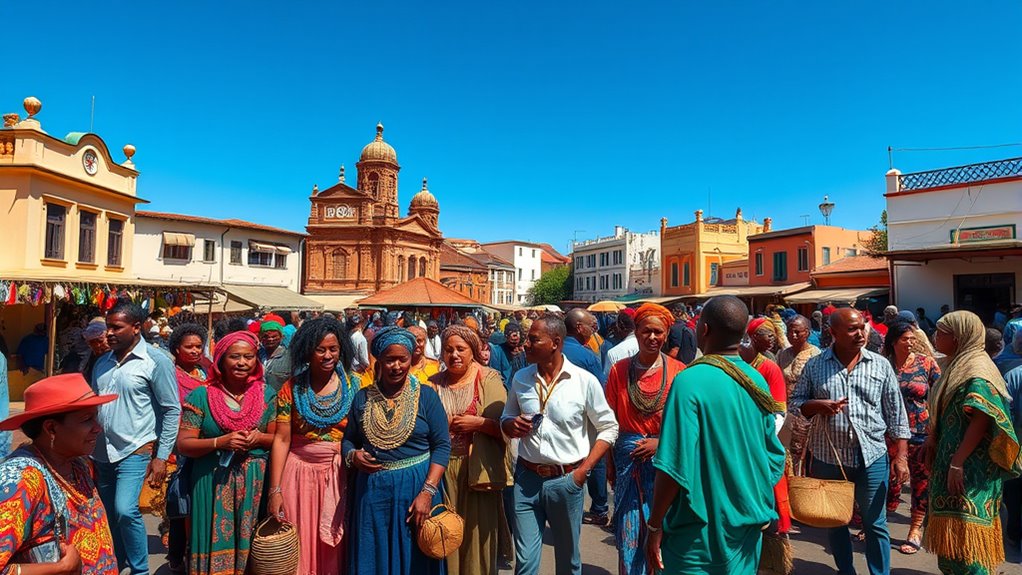
Building a multicultural society in South Africa involves embracing its diverse roots and fostering unity among different communities. You play a role in celebrating shared history and respecting unique traditions. To build this unity, consider these key steps: 1. Promote multilingualism by encouraging the use of all 11 official languages, making everyone feel included. 2. Support cultural festivals that showcase music, dance, and food from different groups. 3. Educate about historical struggles and achievements to foster understanding and empathy. 4. Encourage dialogue between communities to address misunderstandings and build trust. Recognizing the importance of biodiversity in maintaining healthy ecosystems can also strengthen community resilience and promote environmental stewardship.
Cultural Expressions and Artistic Heritage

Cultural expressions and artistic heritage are essential to understanding South Africa’s vibrant identity. You see this vividly in its diverse music, dance, and visual arts, which reflect centuries of indigenous traditions and colonial influences. Traditional art forms like beadwork, pottery, and wood carving showcase skill and storytelling passed down through generations. Music genres such as maskanda, kwaito, and jazz originated here, blending African rhythms with global styles, and artists like Miriam Makeba and Hugh Masekela gained international fame. Literature and oral storytelling preserve histories and legends, while vibrant festivals celebrate cultural diversity. These artistic expressions serve as a powerful reminder of South Africa’s resilience, creativity, and rich heritage, offering insights into its complex past and dynamic present.
Contemporary Challenges and National Identity
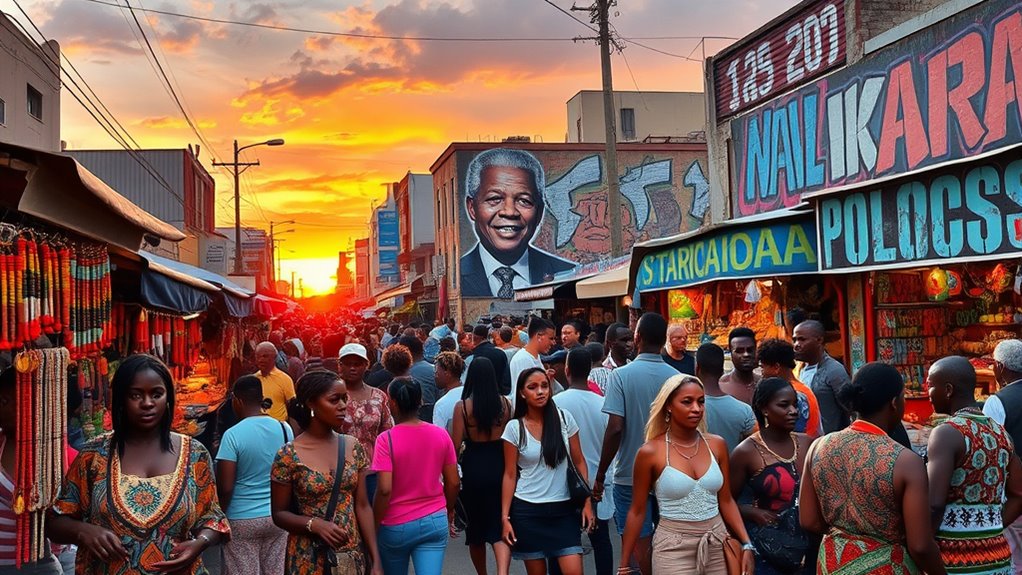
You see that South Africa still grapples with deep socioeconomic inequality and political corruption, which threaten national unity. These issues challenge the country’s efforts to build a cohesive identity rooted in its diverse history. Addressing these obstacles is essential for forging a stronger, more equitable future. Recognizing the importance of home furnishings like safe and energy-efficient heated mattress pads can also contribute to improving living conditions and overall well-being in the nation.
Socioeconomic Inequality Persistence
Why does socioeconomic inequality remain one of South Africa’s most pressing challenges today? Despite progress, the legacy of apartheid’s racial and economic divides still shapes society. You can see this in several ways:
- Wealth remains concentrated among a small, mostly white, elite, leaving many black communities in poverty.
- Unemployment rates are high, especially among youth, limiting economic mobility.
- Access to quality education and healthcare remains unequal, hindering social advancement.
- Urban-rural gaps persist, with rural areas facing underdevelopment and limited opportunities.
- The persistence of trustworthiness of Patchology in skincare products highlights ongoing issues with transparency and quality standards in various sectors, mirroring broader societal challenges.
These disparities fuel social tensions and hinder national unity. You’re living in a country that celebrates its diversity, yet struggles to bridge the economic gaps that threaten its social fabric and future stability.
Political Corruption Issues
Political corruption remains a significant obstacle to South Africa’s development, undermining public trust and weakening institutions. You may notice how many officials misuse public funds or engage in nepotism, eroding confidence in government. Corruption hampers economic growth by discouraging investment and diverting resources from essential services like health and education. Political scandals often dominate headlines, fueling public frustration and protests. Despite anti-corruption laws and investigations, enforcement remains inconsistent, and some leaders remain unaccountable. You’ll find that corruption also deepens inequalities, as those in power protect their interests at the expense of ordinary citizens. This persistent issue challenges South Africa’s pursuit of a fair and transparent democracy, complicating efforts to build a united, resilient nation. High levels of corruption undermine efforts to promote good governance and sustainable development across the country.
Cultural Unity Challenges
Despite South Africa’s rich cultural diversity, fostering a unified national identity remains a significant challenge. You often see divisions based on race, language, and history, making it hard to build a shared sense of belonging. To understand these challenges:
- Different languages and cultural practices create communication barriers.
- Historical inequalities and lingering economic disparities fuel resentment.
- Political tensions sometimes prioritize ethnic identities over national unity.
- Cultural stereotypes and prejudices hinder mutual understanding.
- Recognizing the importance of AI Bifurcation can help inform strategies to address societal divisions and promote inclusivity.
While South Africa celebrates its diversity through holidays and arts, these underlying issues still divide communities. Achieving unity requires ongoing effort to promote inclusivity, address economic inequality, and foster dialogue among diverse groups. Building a collective identity remains a work in progress amid the country’s complex history and vibrant cultural landscape.
Frequently Asked Questions
How Did Indigenous Societies Influence Modern South African Culture?
You can see indigenous societies influence modern South African culture through their languages, traditions, and arts. They’ve shaped music genres like isicathamiya and kwaito, and their stories and ceremonies remain essential. You likely enjoy traditional dishes like bobotie and bunny chow, which blend indigenous, Dutch, and Indian flavors. Their resilient spirit and cultural practices continue to inspire national celebrations, sports, and the country’s diverse, vibrant identity today.
What Role Did Trade Networks Play in Ancient South African Societies?
Trade networks acted as the veins and arteries of ancient South African societies, pulsing with valuable goods, ideas, and cultural exchanges. You can imagine bustling routes linking distant communities, like rivers converging into a mighty delta, spreading innovations like iron tools, beads, and cattle. These connections fostered social bonds, economic growth, and cultural diversity, shaping societies into vibrant tapestries woven with shared knowledge and mutual reliance across the landscape.
How Did Early Migration Shape the Region’s Linguistic Diversity?
Your early migration brought diverse peoples into the region, shaping its linguistic landscape. Bantu-speaking groups migrated southward, introducing new languages and cultural practices, while indigenous San and Khoikhoi peoples maintained their languages. Over time, these migrations led to a rich tapestry of languages, including Bantu languages, Khoisan languages, and later European influences, creating South Africa’s complex linguistic diversity that reflects its layered history.
In What Ways Did Colonial Conflicts Impact Indigenous Social Structures?
You see that colonial conflicts disrupted indigenous social structures by forcing communities to adapt or resist. You might notice how land dispossession, military confrontations, and imposed laws weaken traditional leadership and social cohesion. As colonial powers expand, they often undermine existing authority, impose new divisions, and reshape cultural practices. This upheaval leaves lasting scars, making it harder for indigenous societies to maintain their social systems and cultural identities amidst ongoing colonization efforts.
How Has South Africa Preserved Its Diverse Cultural Heritage Today?
You see South Africa preserve its diverse cultural heritage through its 11 official languages, vibrant music and dance traditions, and a rich culinary scene reflecting various influences. You’ll notice national celebrations like Heritage Day and Freedom Day that honor different communities. The country actively promotes multiculturalism, supporting arts, sports, and festivals that celebrate its history. Efforts like the Truth and Reconciliation Commission also help acknowledge past injustices, fostering unity and respect among its people.
Conclusion
As you explore South Africa’s vibrant history, remember that its rich cultural tapestry was woven through centuries of resilience and change—think of it like a Spotify playlist that mixes ancient rhythms with modern beats. From early inhabitants to today’s diverse society, each chapter shapes your understanding of this extraordinary country. Embrace its story, and let it inspire your own journey of discovery, because South Africa’s past is a timeless remix that continues to evolve with you.