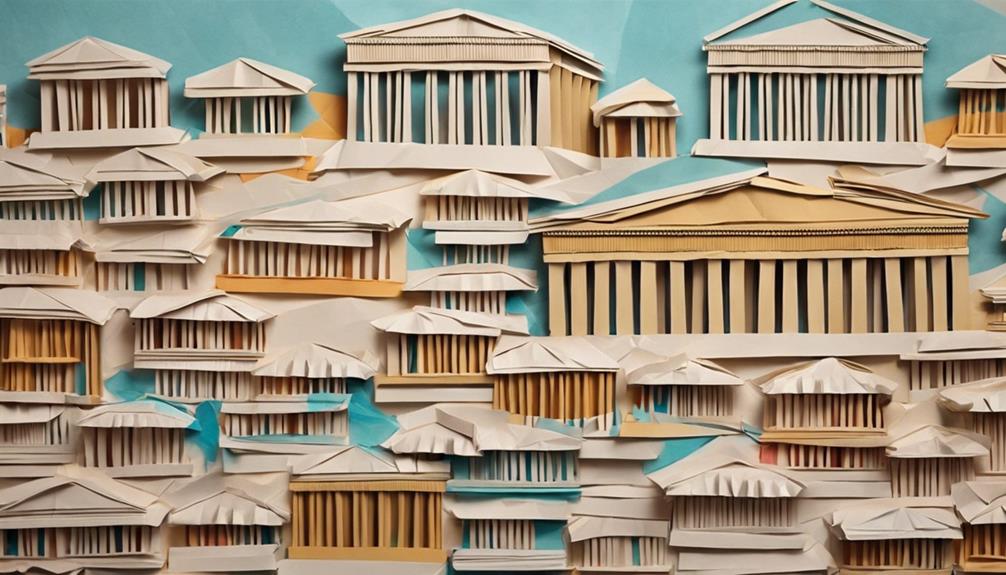
Greece’s history and culture are rich and influential, starting from early farming settlements around 6000 BCE, evolving through the Bronze Age with advanced civilizations like the Minoans and Mycenaeans. After a dark period, Greek city-states emerged, inspiring remarkable achievements in art, philosophy, and architecture during the Classical era. These traditions spread across the Hellenistic world and into the Roman Empire, shaping Western ideas about democracy, art, and science. Exploring Greece’s past reveals a legacy that still influences the modern world today.
Key Takeaways
- Greece’s history spans from early Neolithic settlements through the Bronze Age, culminating in the development of city-states and cultural innovations.
- The Classical period saw advances in art, philosophy, and architecture, shaping Western cultural and intellectual foundations.
- Greek mythology, drama, and epic poetry, notably Homer’s works, are central to Greek cultural identity.
- The Hellenistic era spread Greek influence across the Mediterranean and Near East, blending Greek and local traditions.
- Greek contributions to democracy, philosophy, art, and architecture continue to influence Western civilization today.
Early Civilizations and the Bronze Age in Greece
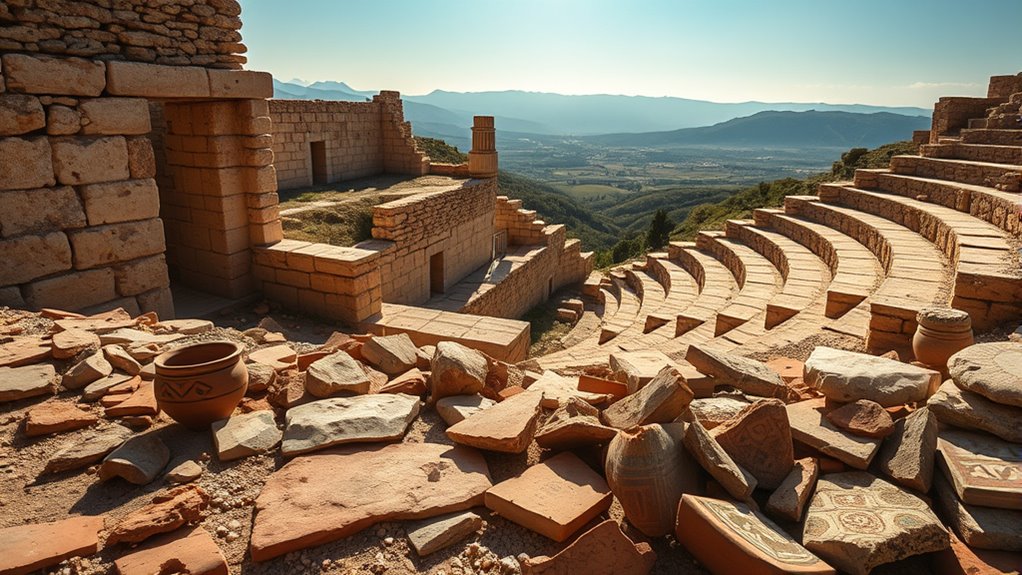
The history of early civilizations in Greece begins around 6000 BCE with the emergence of Neolithic settlements, where people started practicing agriculture and establishing permanent communities. You’ll find that these early societies laid the groundwork for future development, introducing farming techniques and tools that improved daily life. As populations grew, communities became more organized, leading to the rise of specialized crafts and trade. During the Bronze Age, around 2300 BCE, the use of bronze spread across the region, bringing advancements in weaponry and tools. This period also saw the development of complex societal structures, with prominent centers like the Cycladic Islands and Crete. The Minoan civilization emerged on Crete, renowned for its large palaces and maritime prowess, shaping the cultural landscape of Greece for centuries. Bronze Age innovations further contributed to societal complexity and technological progress during this era.
The Greek Dark Age and the Rise of the City-States

When the Mycenaean civilization collapses around 1100 BCE, Greece enters a period of decline known as the Dark Age. During this time, communities reorganize and develop new political structures, leading to the formation of independent city-states called polis. These city-states become the foundation for Greece’s future political and cultural achievements. The sustainable harvesting practices developed during these early times helped ensure the longevity of their natural resources.
Collapse of Mycenaeans
Following the collapse of the Mycenaean palace system around 1100 BCE, Greece entered a period known as the Dark Age, marked by widespread population decline and cultural fragmentation. Many centralized centers disappeared, and writing systems like Linear B vanished, making record-keeping difficult. You’d notice fewer large-scale constructions and a decline in art and craftsmanship. Society shifted toward more localized, simpler communities, often led by chieftains or tribal groups. Trade diminished, and Greece faced invasions, especially by the Dorian people, who settled across the region. This upheaval slowed technological and cultural progress, causing a significant break from the advanced Bronze Age civilization. Over time, however, these hardships laid the groundwork for renewed growth, leading to the emergence of small, independent city-states and new cultural identities. Additionally, the decline of large-scale constructions limited the development of monumental architecture during this period.
Formation of Polis System
After the collapse of the Mycenaean palace system around 1100 BCE, Greece entered a period of decline and cultural fragmentation. During this Dark Age, small villages replaced large centers, and populations shrank. You see local leaders emerging, often warlords or aristocrats, forming the earliest forms of city-states—or poleis. These poleis became centers of identity, politics, and defense. The table below highlights key aspects of this transformation:
| Aspect | Significance |
|---|---|
| Population Decline | Led to smaller, autonomous communities |
| Dorian Influence | Introduced new social and political structures |
| Pottery Styles | Marked cultural continuity and change |
| Settlement Patterns | Concentrated in defensible locations |
| Political Organization | Foundations for later democratic or oligarchic systems |
This evolution set Greece on a path toward the vibrant city-states that define its classical era.
The Cultural Flourishing of Classical Greece
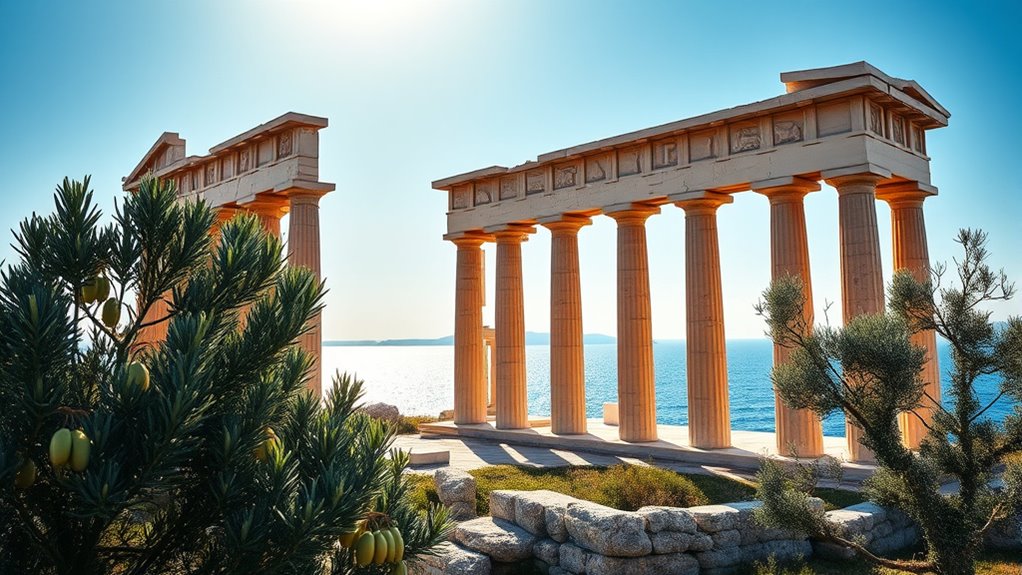
During the Classical period, Greece saw incredible advances in art, philosophy, and literature that still influence us today. You can explore how sculptors created iconic statues and how thinkers like Socrates shaped Western thought. Don’t forget to take into account the plays and writings that laid the foundation for Western drama and storytelling. The development of decorative arts and everyday objects also reflected the evolving cultural identity of Greece during this vibrant era.
Artistic Achievements and Sculpture
The artistic achievements of Classical Greece represent a pinnacle of creativity and technical skill that continues to influence Western culture today. You witness the mastery of sculptors capturing human form, movement, and emotion with remarkable realism. The idealized figures of the Parthenon sculptures exemplify harmony and proportion, shaping Western aesthetic standards. You see how artists like Phidias and Polykleitos perfected techniques such as contrapposto, giving statues lifelike balance and dynamism. Greek architects designed iconic structures like temples with precise symmetry and elegant columns, reflecting their pursuit of beauty and order. These achievements reveal a society dedicated to blending artistry with philosophical ideals, creating works that embody both physical perfection and spiritual significance—an enduring legacy that still influences art and architecture centuries later. The development of color accuracy in sculptures and architectural elements further enhanced the visual harmony and realism, demonstrating the Greeks’ keen attention to detail and aesthetic coherence.
Philosophy and Intellectuals
Have you ever wondered how ancient Greece became the birthplace of Western philosophy? It all started during the Classical Period, when thinkers like Socrates, Plato, and Aristotle challenged traditional beliefs and explored fundamental questions about existence, knowledge, and ethics. You’d find these philosophers engaging in debates at places like the Agora, shaping ideas that still influence us today. They emphasized reason, observation, and critical thinking, moving beyond myth to understand the natural world and human nature. Their work laid the foundation for science, politics, and ethics. Greek intellectuals also contributed to mathematics, astronomy, and medicine, demonstrating a relentless pursuit of knowledge. This era’s intellectual spirit transformed Greece into a hub of innovative thought, leaving a legacy that continues to inspire modern philosophy and sciences. The cultural flourishing of this period created an environment where inquiry and debate thrived, further cementing Greece’s role as a center of intellectual achievement.
Theatre and Literary Works
Ancient Greece’s intellectual breakthroughs extended beyond philosophy into the vibrant worlds of theatre and literature, reflecting the society’s deep appreciation for storytelling, drama, and artistic expression. You witness the birth of drama with playwrights like Aeschylus, Sophocles, Euripides, and Aristophanes, who crafted tragedies and comedies that explore human nature and societal issues. These performances were central to festivals like Dionysia, combining entertainment with moral and political commentary. Literature flourished through epic poetry, especially Homer’s *Iliad* and *Odyssey*, which shaped Greek identity and inspired countless works. You see how storytelling became a crucial part of Greek culture, fostering a legacy that influences Western drama, literature, and theatrical traditions to this day. Additionally, the development of theatrical stagecraft and the establishment of formal dramatic structures laid the foundation for modern theatrical productions.
The Hellenistic Period and the Expansion of Greek Influence
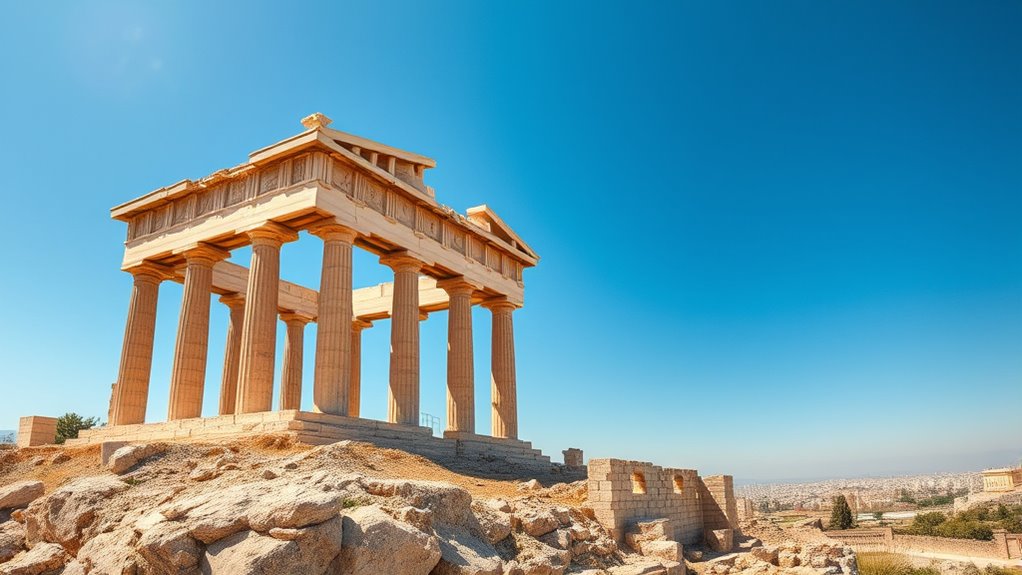
Following the death of Alexander the Great in 323 BCE, Greek culture and influence spread rapidly across the Eastern Mediterranean and Near East. You witness the establishment of Hellenistic kingdoms, blending Greek traditions with local customs. Cities like Alexandria in Egypt become centers of learning, science, and art, attracting scholars such as Euclid and Archimedes. You see Greek language, art, and architecture flourish in new regions, influencing local cultures and fostering trade and diplomacy. The spread of Greek philosophy, science, and governance reaches far beyond Greece itself. You also observe political alliances and conflicts, like the formation of leagues such as the Achaean League, aimed at mutual defense. This period marks a time of cultural diffusion, scientific progress, and expanding Greek influence across a vast and diverse world. The integration of Greek innovations into local traditions further enhanced the (cultural diffusion) and scientific advancements of the era.
Greece Under Roman Rule and Its Cultural Legacy
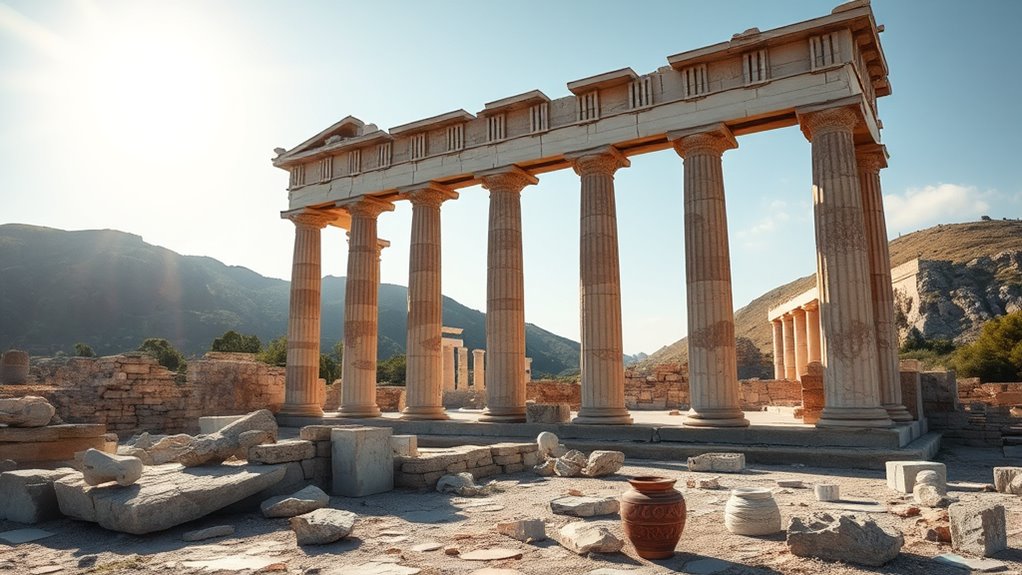
As Greece came under Roman rule after the sack of Corinth in 146 BCE, its rich cultural traditions continued to influence the empire’s art, philosophy, and institutions. You’ll notice how Greek ideas about democracy, rhetoric, and law shape Roman governance and legal systems. Greek art and sculpture remain highly valued, inspiring Roman innovation in portraiture and public monuments. Greek philosophy also deepens Roman intellectual life, with thinkers like Epicureans and Stoics gaining prominence. Despite political subjugation, Greek cities retain their cultural significance, becoming centers of learning and religious practice. The Romans adopt Greek styles in architecture, evident in temples and theaters. Additionally, the transmission of Hellenistic artistic influences throughout the empire contributed to the development of Roman art and architecture. Overall, Greece’s cultural legacy persists, blending with Roman traditions and laying the groundwork for Western civilization’s development.
Contributions to Philosophy, Art, and Architecture
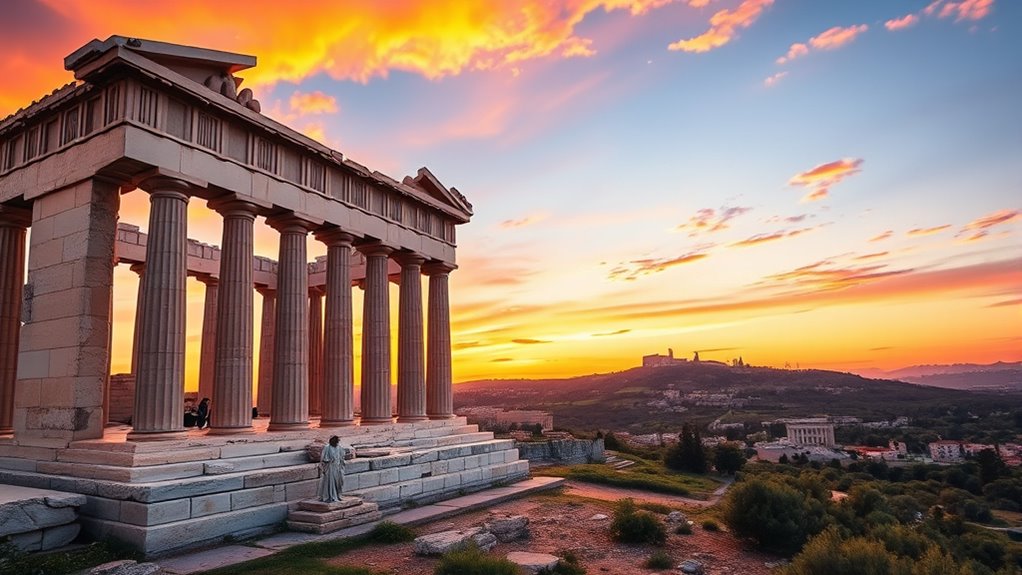
Greek contributions to philosophy, art, and architecture have left an indelible mark on Western civilization, shaping ideas and aesthetics that still resonate today. You see their influence in the foundations of Western thought, with philosophers like Socrates, Plato, and Aristotle questioning existence, ethics, and knowledge. Their ideas fostered critical thinking and democracy. In art, Greek sculptors perfected naturalism, producing iconic works like the Discobolus and the Venus de Milo. Architecturally, they pioneered the use of columns and symmetry, exemplified by the Parthenon, which embodies harmony and proportion. These innovations set standards for beauty, balance, and intellectual pursuit, inspiring countless civilizations afterward. Their legacy endures in modern philosophy, art, and architecture, shaping the way you think about beauty, structure, and the pursuit of knowledge. Additionally, their advancements in building techniques laid the groundwork for future architectural innovations.
The Enduring Impact of Ancient Greece on the Modern World
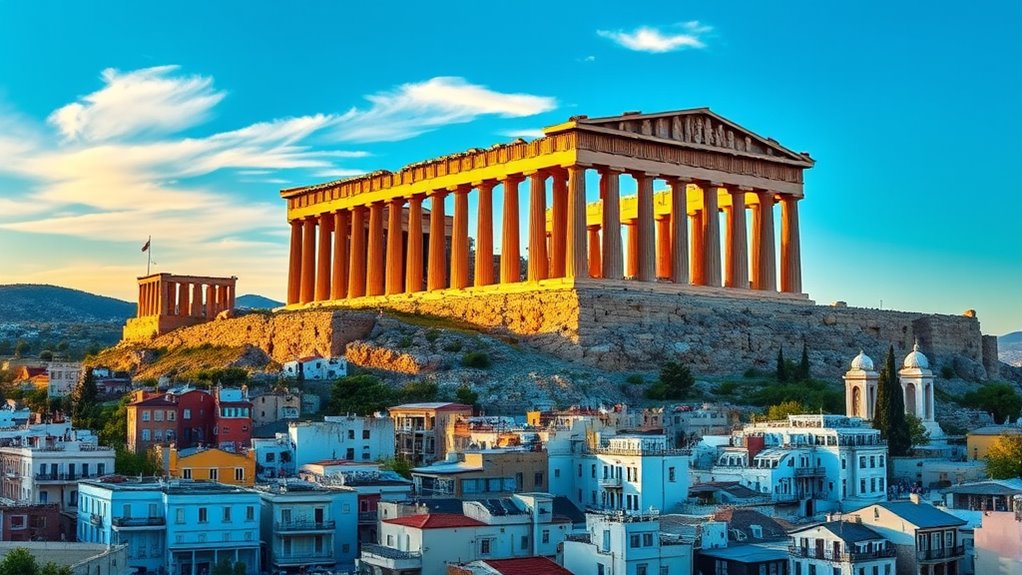
The influence of ancient Greece continues to shape your modern world in profound ways, especially through its contributions to democracy, philosophy, and art. You benefit from the idea of political participation, rooted in Athens’ early democratic practices, which inspire current governments. Greek philosophers like Socrates, Plato, and Aristotle laid the groundwork for Western thought, shaping ethics, science, and logic that still influence your worldview. In art and architecture, Greek styles—columns, temples, sculptures—remain iconic and inspire design today. Greek drama and literature set standards for storytelling, drama, and theatrical performance. Overall, Greece’s innovations in governance, intellectual pursuits, and cultural expression continue to influence your laws, education, arts, and ideas, making its legacy an enduring part of your daily life.
Frequently Asked Questions
How Did Greek Religion Influence Their Daily Life and Politics?
Greek religion deeply influences your daily life and politics by shaping your values, rituals, and social structures. You participate in festivals, honor gods like Zeus and Athena, and seek their favor through offerings and prayers. Politics often revolve around religious rituals, with leaders consulting oracles and building temples to demonstrate piety. Religion reinforces community bonds and justifies laws, ensuring that divine approval guides your decisions and societal order.
What Roles Did Women Play in Ancient Greek Society?
Ever wonder what women’s lives looked like in ancient Greece? They mainly managed household chores, raised children, and participated in religious festivals. Women had limited political power and rarely engaged in public life. Did they have any influence outside their homes? Some, especially priestesses or those in aristocratic families, held religious or social roles. Still, their primary role was supporting family and community, shaping the society in subtle yet crucial ways.
How Did Greek Warfare Evolve Over Different Periods?
You see Greek warfare evolve from simple tribal conflicts to highly organized battles. During the Archaic and Classical periods, hoplite soldiers in phalanxes dominated, emphasizing heavy armor and spear tactics. As time progresses, innovations like the use of cavalry and naval power emerge, especially with the rise of Athens’ navy. Eventually, Hellenistic armies incorporate new weapons and strategies, reflecting Greece’s adaptation to changing warfare styles.
What Was Daily Life Like for Ordinary Ancient Greeks?
Imagine life as a woven tapestry, each thread representing daily routines. You wake early, tending to your farm or craft, sharing meals with family, and participating in local festivals or markets. Men often train for warfare, while women manage households and children. Social life revolves around community gatherings, religious rituals, and storytelling. Though struggles exist, your daily life flows like a steady river, shaping the vibrant fabric of ancient Greek society.
How Did Greek Mythology Shape Their Cultural Identity?
Greek mythology shapes your cultural identity by providing a shared set of stories that explain the world, gods, and human nature, giving you a sense of belonging and moral guidance. These myths influence your art, literature, and religious practices, reinforcing values like heroism, honor, and hospitality. They also connect you to your ancestors’ beliefs, creating a lasting cultural legacy that defines your understanding of life and the universe.
Conclusion
You can see how Greece’s rich history shapes our world today. Imagine visiting Athens and standing in the Parthenon, feeling connected to ancient philosophers like Socrates. By exploring Greece’s culture, you get a glimpse of its lasting influence—on democracy, art, and ideas. So, next time you think about history, remember Greece’s incredible journey from early civilizations to a legacy that still inspires us all today.