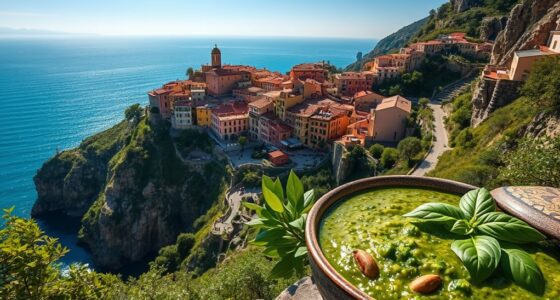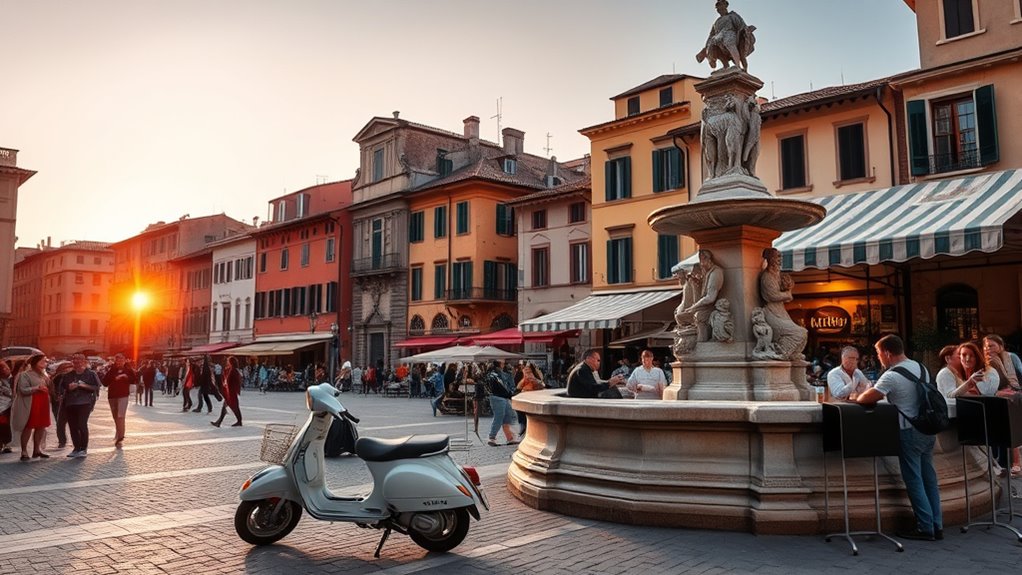

Italy’s history spans from early human settlements over 48,000 years ago to the rise of civilizations like the Etruscans and Greeks. You’ll find that ancient Rome’s empire shaped law, architecture, and culture, while medieval city-states fostered innovation and diversity. The Renaissance revolutionized art and science, influencing the world. Fragmented yet united by leaders like Garibaldi, Italy’s modern identity blends rich heritage with artistic and cultural achievements—an ongoing story you can explore in more detail.
Key Takeaways
- Italy’s history spans from early human settlements over 48,000 years ago to the rise of powerful civilizations like the Etruscans, Greeks, and Romans.
- The Roman Empire’s expansion, law, and infrastructure significantly shaped Italy’s political and cultural development.
- Medieval Italy was characterized by fragmented city-states, maritime republics, and regional conflicts fostering diverse cultures.
- The Renaissance transformed Italy into a global hub of art, science, and innovation, producing renowned artists and architects.
- Italy’s unification in the 19th century, led by key figures like Garibaldi and Cavour, established modern Italy’s national identity.
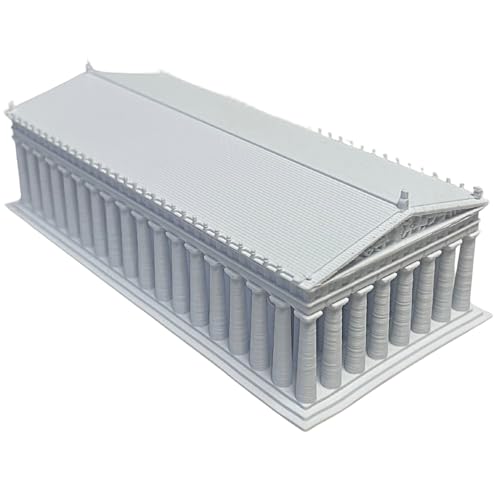
Sands3D™ Parthenon Model – Miniature Greek Temple Replica, Ancient Architecture Display, Classical Landmark Collectible
🏛️ Exquisite Parthenon Replica – A beautifully crafted miniature of the historic Greek Parthenon, showcasing its iconic columns…
As an affiliate, we earn on qualifying purchases.
As an affiliate, we earn on qualifying purchases.
Early Human Settlements and Ancient Civilizations in Italy

Human presence in Italy dates back at least 48,000 years, as archaeological discoveries show. You can explore ancient tools and fossils that reveal early humans settled in this region long before recorded history. Around 800 BC, the Etruscans established a sophisticated civilization in central Italy, leaving behind impressive art, architecture, and tombs. In southern Italy, Greek colonists began arriving from 750 BC, founding cities that formed Magna Graecia, influencing local culture and trade. During this period, the Iron Age coincided with the rise of these early Italic peoples. These civilizations laid the groundwork for Italy’s rich cultural tapestry, showcasing advanced skills in metallurgy, art, and social organization, which would influence later societies across the Mediterranean and beyond. Additionally, the early human settlements contributed to the development of complex societal structures and cultural practices that persisted through subsequent millennia.

Roman Law and the Legal World of the Romans
As an affiliate, we earn on qualifying purchases.
As an affiliate, we earn on qualifying purchases.
The Rise of the Roman Kingdom and Republic
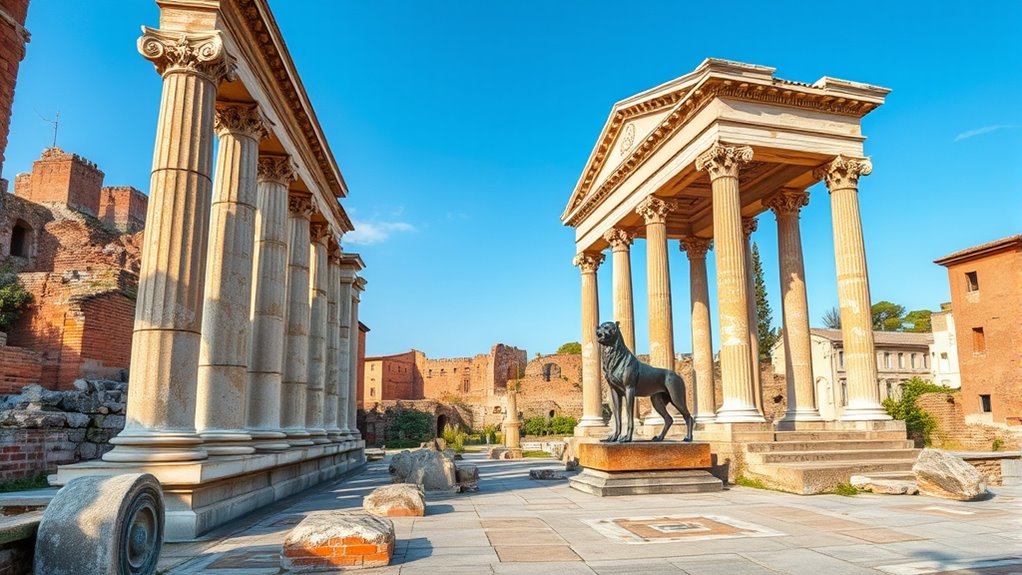
How did Rome shift from a small settlement to a powerful republic? You start with a modest village founded in 753 BC, ruled by kings. Around 509 BC, you overthrow the monarchy, establishing the Roman Republic. You develop a complex system of governance with elected officials called consuls and a Senate that guides decision-making. As you grow, you conquer neighboring tribes and Greek colonies, expanding your influence across Italy. You create a society rooted in law, military strength, and alliances. Over time, your political structures become more sophisticated, balancing power among different classes. Through strategic diplomacy and military prowess, you become a dominant force in Italy. This period marks Rome’s transformation from a small settlement into a burgeoning republic that lays the foundation for future empire-building.

MINI ZOZI Famous Art Prints And Posters 16PCS Paintings Fine Art Impressionist Renaissance Aesthetic Romanticism Big Poster Wall Painting Classroom Room Decor Classical America Artist Artwork Pack
Our Classic Famous Art Prints And Poster Packs Are Ideal For Decorations Of Home, Bedroom, Living Room, Dining…
As an affiliate, we earn on qualifying purchases.
As an affiliate, we earn on qualifying purchases.
Expansion and Empire of Ancient Rome
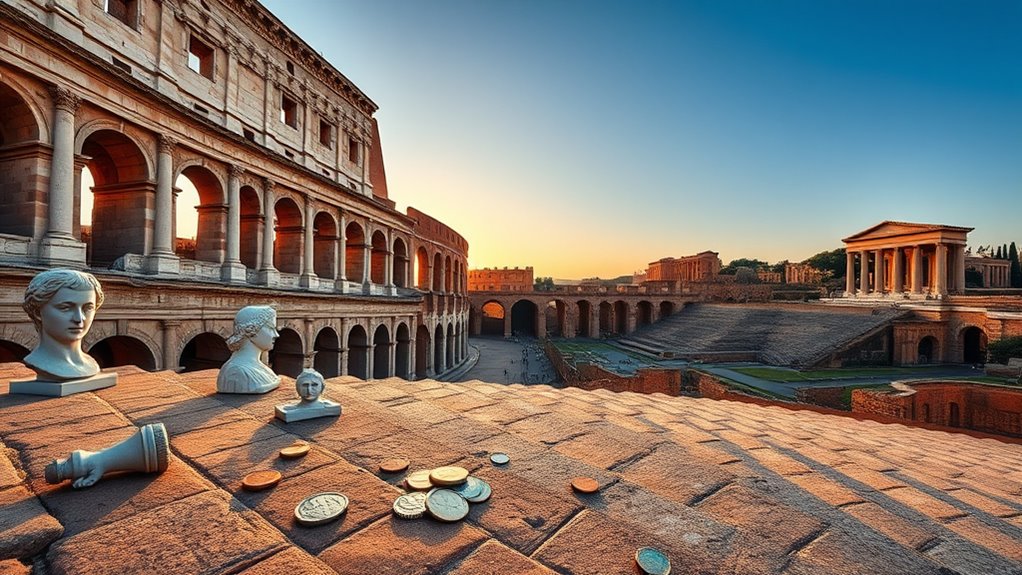
After establishing a stable republic and expanding across Italy, Rome set its sights on wider horizons. You witness Rome’s military prowess and strategic diplomacy as it defeats rival tribes and Greek colonies, consolidating power. You see the development of roads, aqueducts, and armies that support expansion. Rome’s conquest of Carthage in the Punic Wars grants control over the Western Mediterranean. You notice Rome’s governance evolve, with provinces, governors, and Roman law spreading influence. Julius Caesar’s campaigns and reforms push the boundaries further, leading to the rise of the Empire under Augustus. The empire’s vast territory includes Europe, North Africa, and the Middle East, creating a multicultural empire. You observe the Pax Romana, a period of stability, trade, and cultural exchange that cements Rome’s imperial dominance.

Maps International – Italy Map – Classic Italy Map Poster – Single Side Laminated – 16.5 x 23.4 inches
Maps International – Map Italy of – Poster with map of Italy classic style
As an affiliate, we earn on qualifying purchases.
As an affiliate, we earn on qualifying purchases.
Medieval Fragmentation and City-States
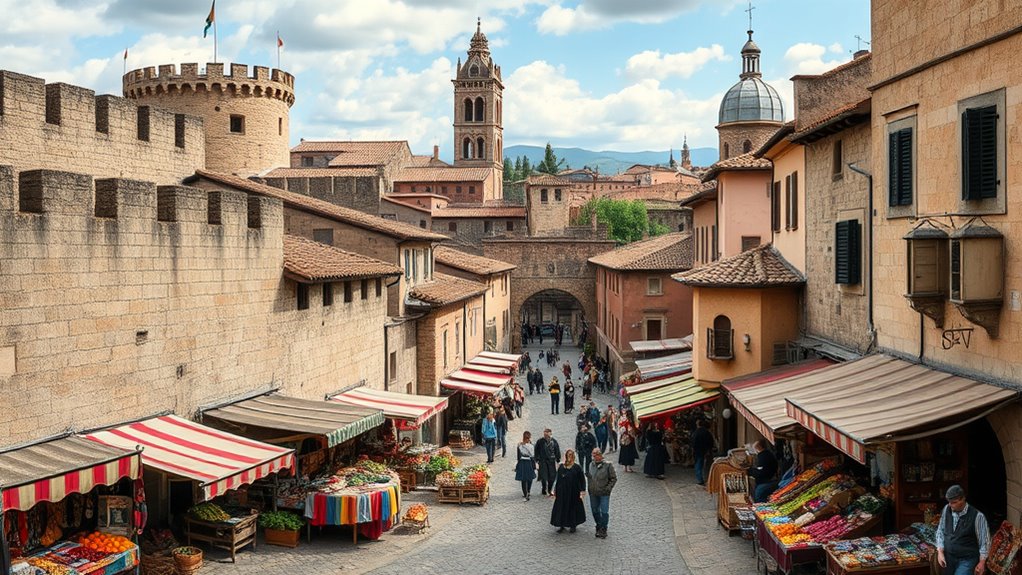
You’ll see how Italy fractured into numerous city-states and regions after Rome’s fall, each with its own loyalties and power struggles. Maritime republics like Venice and Genoa rose to prominence by controlling trade and naval dominance. Meanwhile, the Papal States emerged as a major religious and political force, shaping Italy’s medieval landscape through their influence. The medieval fragmentation led to diverse cultural developments and the rise of independent city-states that would influence Italy’s history for centuries.
Rise of Maritime Republics
During the Middle Ages, Italy fragmented into a patchwork of independent city-states and maritime republics, each vying for economic and political dominance. Venice, Genoa, and Pisa rose as powerful maritime hubs, controlling trade routes across the Mediterranean. These republics thrived through commerce, naval strength, and strategic alliances, shaping Italy’s political landscape. Their governments varied from oligarchies to merchant-led councils. Here’s a closer look:
| City | Key Strengths | Notable Achievements |
|---|---|---|
| Venice | Naval dominance, finance | Controlled Eastern trade, built canals |
| Genoa | Maritime trade, shipbuilding | Wealth from Mediterranean routes |
| Pisa | Naval power, engineering | Influenced Mediterranean politics |
Additionally, their naval dominance played a crucial role in establishing their economic and military power throughout the Mediterranean region.
Power of the Papal States
As Italy’s maritime republics flourished through trade and naval power, the political landscape became increasingly fragmented, paving the way for the rise of powerful city-states like the Papal States. You see, the Papal States grew into a dominant religious and political force in central Italy, wielding influence far beyond spiritual matters. Their power was rooted in the authority of the Pope, who controlled vast territories and leveraged diplomatic and military strength. The Papal States:
- Maintained their independence amid regional conflicts
- Negotiated alliances with local rulers
- Exercised authority over church doctrine and secular governance
- Influenced European politics through diplomacy and papal bulls
This combination of religious authority and territorial control made the Papal States a key player in medieval Italy’s complex landscape, shaping both politics and culture across the continent. Ethical Hacking techniques were sometimes employed to protect their digital communications and maintain their influence in an increasingly connected world.
Fragmentation and Local Loyalties
After the fall of the Roman Empire, Italy fractured into numerous independent city-states and small kingdoms, each with its own government, military, and economic interests. You’ll notice cities like Venice, Florence, and Genoa asserting their independence, often competing fiercely for trade and power. These city-states develop unique identities, laws, and alliances, fostering strong local loyalties. Instead of unified authority, you see a patchwork of rulers, including Lombard dukes, Byzantine administrators, and emerging merchant republics. This fragmentation creates a vibrant, competitive environment that drives innovation in politics, commerce, and culture. However, it also leads to constant conflict and shifting alliances, making Italy a land of diverse sovereignties and complex loyalties. The presence of competing city-states encourages regional pride and fosters a sense of local identity that persists to this day. Your experience of Italy during this period is one of regional pride and fierce independence.
The Italian Renaissance and Artistic Achievements
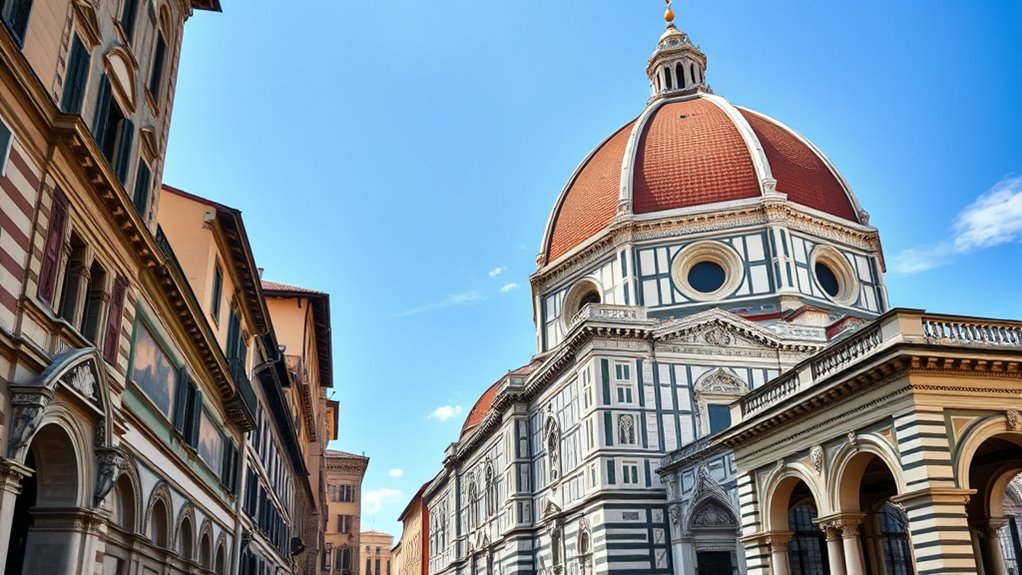
Have you ever wondered what sparked the extraordinary cultural revolution known as the Italian Renaissance? It was a burst of creativity that transformed art, science, and ideas. During this period, you’ll see how Italy’s city-states became hubs of innovation, attracting talented artists and thinkers.
- Artists like Leonardo da Vinci, Michelangelo, and Raphael pushed boundaries with realistic techniques and new perspectives.
- Architecture evolved with grand structures such as Brunelleschi’s dome in Florence.
- Literature flourished, emphasizing human experience and classical themes.
- Scientific inquiry advanced, blending observation with artistic mastery.
- The Renaissance also saw the development of vetted innovative artistic techniques, which helped artists achieve unprecedented realism and depth in their work.
This era celebrated human potential and revived classical antiquity, shaping modern Western culture. You can still admire the beauty and ingenuity of Renaissance achievements today, echoing Italy’s artistic and intellectual legacy.
Path to Unification and Modern Statehood
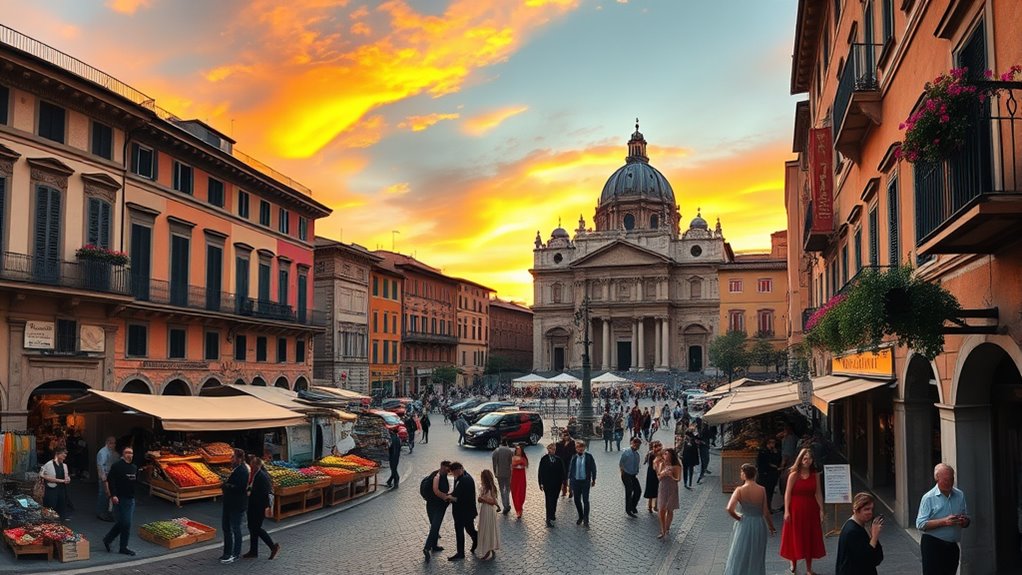
You see, the Risorgimento movement was essential in uniting Italy, driven by leaders like Mazzini, Cavour, and Garibaldi. These figures worked tirelessly to forge a single nation, with Piedmont-Sardinia leading the charge. The final step came in 1870 when Rome was captured, completing Italy’s unification and establishing its modern statehood. Safety in Shark-Infested Waters was also a crucial consideration during this period of expansion and nation-building, ensuring the protection of citizens and explorers alike.
Risorgimento Movement Achievements
The Risorgimento movement transformed Italy from a patchwork of fragmented states into a unified nation. You witness how it ignited a national identity and drove political change. The movement achieved several key milestones:
- Led military campaigns with figures like Garibaldi, conquering Sicily and Naples.
- Established Piedmont-Sardinia as the driving force behind unification under King Victor Emmanuel II.
- Formed alliances with France and other powers to weaken Austrian influence in northern Italy.
- Captured Rome in 1870, making it the capital and symbol of Italian unity.
- The movement also fostered a sense of national identity, unifying diverse regions under a common cultural and political banner.
Through these efforts, Italy transitioned from a collection of independent kingdoms to a unified modern state, setting the foundation for its future development and international presence.
Key Unification Figures
Key figures of Italy’s unification played pivotal roles in transforming fragmented states into a cohesive nation. Giuseppe Mazzini inspired patriotism and promoted republican ideals, rallying Italians around a shared identity. Camillo Cavour, as the Prime Minister of Piedmont-Sardinia, expertly negotiated alliances and modernized the state’s economy, paving the way for unification. Giuseppe Garibaldi led the famous Red Shirts, executing daring military campaigns that unified southern Italy with the north. Victor Emmanuel II, king of Sardinia, ultimately became Italy’s first king, symbolizing national unity. Together, these leaders coordinated efforts—militarily, politically, and diplomatically—to end centuries of division. Their combined efforts laid the groundwork for Italy’s emergence as a unified modern state, setting the stage for its future growth and development. The top 10 anime films and animated movies that touch hearts can serve as cultural representations of Italy’s rich artistic heritage and storytelling traditions.
Rome’s Final Capture
After years of political maneuvering, military campaigns, and diplomatic efforts by leaders like Garibaldi and Cavour, the path to unification reached its climax with the capture of Rome. You witness the culmination of Italy’s long struggle to unify, as the Italian army advances on the Papal States. The Italian troops face little resistance, and Rome’s fall marks the final piece of the puzzle. The use of modern military technology played a significant role in ensuring the swift victory.
- The Italian army enters Rome in 1870, ending papal sovereignty.
- The Papal States become part of the newly unified Italy.
- Rome is declared the capital of Italy, symbolizing unity.
- The Pope’s temporal power diminishes, setting the stage for modern statehood.
This decisive moment transforms Italy from fragmented regions into a unified nation, shaping its future.
Italy’s Political and Cultural Transformation in the 19th and 20th Centuries

Italy underwent profound political and cultural changes during the 19th and 20th centuries, transforming from a patchwork of fragmented states into a unified nation. You witness the Risorgimento, where leaders like Mazzini, Cavour, and Garibaldi rally for independence and unity. Piedmont-Sardinia’s leadership, under Victor Emmanuel II, culminates in Rome’s capture in 1870, establishing Italy as a kingdom. Throughout this period, Italy experienced rapid industrialization, social shifts, and political upheavals, including two World Wars that deeply affected its identity. Culturally, the country flourished, with the rise of modernism and significant contributions to art, literature, and cinema. Italy’s transformation fosters a sense of national pride, shaping its modern political landscape and cultural outlook, blending its rich historical roots with contemporary innovations.
Italy’s Contemporary Cultural Identity and Global Influence
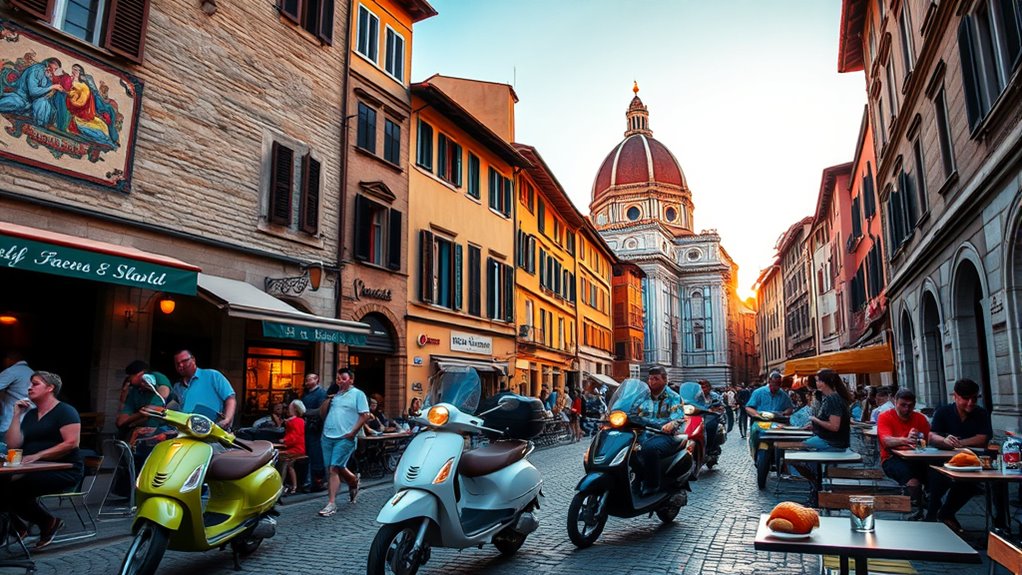
Contemporary Italy continues to shape its identity through a vibrant blend of tradition and innovation that resonates worldwide. You experience this influence daily through its renowned cuisine, fashion, and arts. Italy’s global reach is evident in:
Contemporary Italy blends tradition and innovation, shaping global influence through cuisine, fashion, and arts.
- Its iconic cuisine, with regional dishes like pasta, pizza, and Gelato.
- The international popularity of Italian fashion houses and designers.
- The worldwide admiration for Italian opera, music, and film industries.
- The widespread recognition of Italian cities as UNESCO World Heritage sites.
This cultural richness fosters a strong sense of regional pride and family values, which remain central to modern life. Italy’s ability to honor its past while embracing innovation sustains its position as a powerful cultural force on the world stage.
Italy’s Heritage Sites and Regional Diversity

Italy’s rich cultural landscape is vividly reflected in its numerous UNESCO World Heritage sites, which showcase the nation’s diverse history and regional identities. From the ancient ruins of Pompeii to Venice’s unique waterways, each site tells a story of Italy’s past. The country’s regions boast distinct traditions, cuisines, and architecture, creating a vibrant mosaic. Imagine the contrasting landscapes:
| Mountainous Alps and Dolomites | Rolling Tuscan Hills and vineyards | Coastal Amalfi and Cinque Terre | Historic cities like Rome and Florence |
|---|---|---|---|
| Snow-capped peaks and alpine charm | Sun-drenched, lush landscapes | Colorful seaside villages | Artistic centers of Renaissance |
These sites and regions celebrate Italy’s heritage, offering an immersive experience of its cultural diversity.
Frequently Asked Questions
How Did Italy’s Regional Cultures Influence Its National Identity?
You see Italy’s regional cultures shaping its national identity through diverse traditions, dialects, and cuisines that reflect local histories. These differences foster a sense of pride and community, even as they unite under a shared language and heritage. By embracing regional customs, you experience Italy’s rich tapestry, where local identities contribute to a strong, vibrant national culture that celebrates both diversity and unity.
What Role Did Italy Play in Major European Conflicts?
Italy played a dramatic role in European conflicts, often stealing the spotlight with flair. You witness its city-states fighting fierce maritime battles, while unification wars made headlines across the continent. During both World Wars, Italy switched sides like a fashionista changing outfits. Today, Italy continues to influence peace talks and NATO, proving it’s not just about pasta and pizza, but also about making history—and occasionally, a bit of chaos.
How Has Italian Cuisine Evolved Over Centuries?
You see, Italian cuisine has evolved through centuries of regional influences, trade, and cultural exchange. You’ll notice how ancient Roman ingredients and techniques blended with Mediterranean flavors during the Renaissance, leading to iconic dishes like pasta and pizza. Over time, local ingredients and traditions shaped regional specialties. Today, Italian cuisine continues to innovate while honoring its rich history, making it one of the most beloved culinary traditions worldwide.
What Are Italy’s Most Famous Contributions to Fashion and Design?
Italy’s fashion and design are like a vibrant tapestry woven with elegance, innovation, and centuries of artistry. You’ll recognize legendary brands like Gucci, Prada, and Valentino, each setting global trends with their craftsmanship. Italy’s design influence extends from haute couture to sleek furniture, blending timeless tradition with modern flair. When you wear Italian fashion, you’re draping yourself in a legacy that’s as rich and stylish as the country itself.
How Does Italy Preserve Its Ancient and Renaissance Heritage Today?
You can see Italy preserves its ancient and Renaissance heritage through its well-maintained archaeological sites, museums, and historic city centers, which attract millions of visitors annually. Restoration projects safeguard monuments like the Colosseum and Florence’s art collections. Additionally, Italy promotes cultural education and supports local artisans who continue traditional crafts. UNESCO World Heritage sites across the country further guarantee that Italy’s rich history remains protected and celebrated for future generations.
Conclusion
As you explore Italy’s rich tapestry of history and culture, you’ll see it’s like a timeless mosaic, each piece shining with stories of ancient civilizations, artistic brilliance, and resilient spirit. From mighty empires to vibrant city-states, Italy’s legacy continues to dance like sunlight on rolling hills. Embrace its diverse heritage, for in Italy’s story, you find the heartbeat of a nation that forever paints its history across the canvas of the world.