
Portable outdoor cookware presents a practical tradeoff: carry less weight and cook efficiently, or accept a heavier kit that can take more abuse. Hard-anodized aluminum cookware and stainless steel cookware are common choices for campers, but they suit different trips. Aluminum is the stronger fit for backpackers and anyone who values compact, responsive cooking; stainless steel makes more sense for car campers, frequent group meals, and users who put toughness ahead of pack weight. The differences in weight and heat control are substantial, while cost, cleaning, and long-term value depend on the specific set and how it will be used.

Get travel and outdoor gear delivered free with Prime
- Fast, free delivery on millions of items
- Prime Video, Amazon Music and more included
- Member-only deals all year
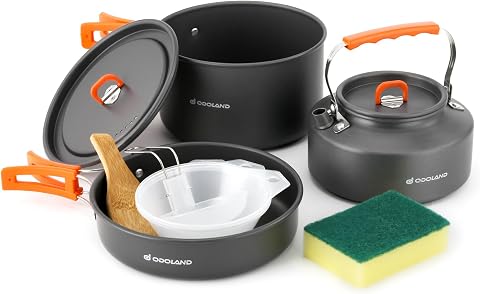
Odoland 10pcs Camping Cookware Set with Pot, Fry Pan, Kettle, Plastic Bowls and Soup Spoon
- ✔ Pieces: 11 listed components
- ✔ Material: Anodized aluminum pots and pan; plastic bowls; bamboo spatula
- ✔ Weight: 1.7 lb

MalloMe Camping Cookware Mess Kit for Backpacking Gear
- ✔ Pieces: 17
- ✔ Material: Hard-anodized aluminum
- ✔ Weight: Not specified

Odoland 19pcs Camping Cookware Mess Kit, Non-Stick Pot Pan Kettle Set for 2
- ✔ Pieces: 19
- ✔ Body material: Hard-anodized aluminum with nonstick surface
- ✔ Weight: 2.75 lb
At a Glance
| Criteria | Hard-anodized aluminum cookware | Stainless steel cookware | Winner |
|---|---|---|---|
| Weight and packability | Usually lighter; easier to carry in a backpack | Usually heavier and bulkier for the same capacity | A |
| Heat distribution | Heats quickly and generally distributes heat evenly | Can develop hot spots and respond more slowly to heat changes | A |
| Durability | Hard surface resists wear, but can be dented or damaged by rough treatment | Resists dents and rough handling; can last for years with basic care | B |
| Cooking versatility | Works well for boiling, simmering, and everyday camp meals; coating varies by set | Handles a wide range of camp cooking, including utensils and hotter cooking | Depends |
| Cleaning and maintenance | Often easy to clean, especially with a nonstick interior; avoid damaging coatings | Can require more scrubbing when food sticks; no coating to protect on many sets | Depends |
| Typical cost and value | Often affordable; pays off most when lower carry weight matters | Prices vary; worth paying for if toughness and long use matter more than weight | Depends |
Odoland 10pcs Camping Cookware Set with Pot, Fry Pan, Kettle, Plastic Bowls and Soup Spoon
For campers who want a cooking kit without carrying a full dinnerware service, the Odoland 10-piece set makes the strongest all-around case. Its stated 1.7 lb weight is lower than the 2.75 lb listed for the Odoland 19-piece set, while its 2 L pot is also slightly larger than that set’s 1.9 L pot. A 1.1 L kettle and 0.7 L fry pan round out the cooking pieces, giving us more flexibility than a pot-only kit.The tradeoff is in the eating gear: the included plastic bowls are lighter than the stainless steel cups and plates in the other two sets, but they may feel less robust. The MalloMe kit includes stainless tableware and cutlery in its 17-piece package, while this Odoland prioritizes a lighter stated carry weight. Foldable insulated handles and a mesh bag support compact packing, and the anodized nonstick surfaces should simplify cleanup. Still, the relatively small pot is better for modest portions than group meals, and coated cookware calls for gentle utensils and heat management.
Pros:
- Stated weight is 1.7 lb, the lightest specified in this comparison.
- 2 L pot capacity is the largest listed among these sets.
- Includes a kettle, fry pan, three plastic bowls, and basic cooking accessories.
- Foldable insulated handles and mesh bag support compact packing.
Cons:
- The 2 L pot may be limiting for larger groups or batch cooking.
- Plastic bowls are less sturdy than the stainless steel tableware in the other kits.
- Nonstick surfaces require care with heat and utensils.
Best for: Campers and backpackers who value a low stated carry weight, want a kettle and pan, and can make do with plastic bowls.
Not ideal for: Groups needing large meal portions or buyers who prefer metal plates and cups for a sturdier table setting.
Bottom line: We rank this first for its combination of the lowest stated weight, the largest listed pot, and a useful set of cooking pieces, with less durable bowls as the main compromise.
“We rank this first for its combination of the lowest stated weight, the largest listed pot, and a useful set of cooking pieces, with less durable bowls as the main compromise.”
MalloMe Camping Cookware Mess Kit for Backpacking Gear
The MalloMe kit suits campers who would rather pack one coordinated set than assemble cookware and tableware separately. Its 17-piece lineup pairs a 1.7 L pot and 1.15 L kettle with a 7-inch pan, stainless steel cups and plates, cutlery, and cleaning accessories. Compared with the Odoland 10-piece, it gives us more clearly specified eating gear; compared with the Odoland 19-piece, it lists a larger kettle and a wider pan.That completeness has a carrying cost to consider. The product is designed to nest, which helps reduce bulk, but its full-set weight is not provided; the Odoland 10-piece’s 1.7 lb figure offers more certainty for weight-conscious hikers. MalloMe’s hard-anodized aluminum and heat-resistant handles are intended for practical outdoor cooking, and the set description says it can be used on portable stoves or campfires. The 1.7 L pot is the smallest of the three listed capacities, however, and this many pieces may be unnecessary for solo trips or minimalist packing. We’d choose it when tableware coverage matters more than a known low carry weight.
Pros:
- 17-piece kit includes stainless steel cups and plates, cutlery, and cleaning accessories.
- Nesting design is intended to reduce packed bulk.
- 1.15 L kettle is the largest listed in this comparison.
- Hard-anodized aluminum construction and heat-resistant handles are specified.
Cons:
- The full kit weight is not stated, making pack-weight comparisons difficult.
- Its 1.7 L pot is the smallest listed here.
- The complete set may include more tableware than solo campers need.
Best for: Campers who want cookware, stainless steel tableware, and cutlery together for shared meals and value nesting storage.
Not ideal for: Ultralight hikers who need a verified low total weight, or solo campers unlikely to use the extra plates, cups, and cutlery.
Bottom line: We place MalloMe second for its useful shared-meal setup and largest listed kettle, while the unspecified total weight and smaller pot keep it behind the lighter, better-quantified overall pick.
“We place MalloMe second for its useful shared-meal setup and largest listed kettle, while the unspecified total weight and smaller pot keep it behind the lighter, better-quantified overall pick.”
Odoland 19pcs Camping Cookware Mess Kit, Non-Stick Pot Pan Kettle Set for 2
When the goal is to cook and eat as a pair from one packed kit, this Odoland 19-piece set is the most explicit match. It includes two stainless steel cups, two plates, and two sets of foldable cutlery alongside a 2 qt pot, pan, and kettle. The stated 2.75 lb weight and compact mesh-bag dimensions give us a concrete packing picture, unlike the MalloMe kit, whose total weight is not listed.Its capacity mix is less compelling for boiling water: the 1.9 L pot is close to the 2 L pot in the lighter Odoland 10-piece, but the kettle holds only 0.8 L, below both alternatives. The 5.7-inch pan is also smaller than MalloMe’s 7-inch pan. In exchange, this kit provides a complete two-person place setting with metal cups and plates, a clear advantage over the 10-piece set’s plastic bowls. Hard-anodized aluminum is described as suitable for stoves or campfires, though the nonstick coating needs careful handling; metal utensils and excessive heat can damage it. The added tableware and known weight make this a less attractive choice for solo or weight-sensitive hikers.
Pros:
- Includes two stainless steel cups, plates, and cutlery sets.
- Nesting pieces pack into a bag measuring 7.5 x 7.5 x 5 inches.
- 2 qt (1.9 L) pot supports meals for one or two people.
- Hard-anodized aluminum and a cleaning cloth are specified.
Cons:
- At 2.75 lb, it is heavier than the stated 1.7 lb Odoland 10-piece set.
- Its 0.8 L kettle is the smallest listed in this comparison.
- Nonstick coating can be damaged by metal utensils or high heat.
Best for: Two campers who want one compact kit with two metal place settings, cookware, and a stated packed weight.
Not ideal for: Solo backpackers prioritizing the lowest carry weight, or campers who need a larger kettle or broader pan for cooking.
Bottom line: We recommend it for pairs who prioritize a complete metal place setting, but its weight and smaller kettle make it a less flexible backpacking choice than the top-ranked Odoland set.
“We recommend it for pairs who prioritize a complete metal place setting, but its weight and smaller kettle make it a less flexible backpacking choice than the top-ranked Odoland set.”
As an Amazon Associate we earn from qualifying purchases.
Key Differences
The main distinction is how each material handles the demands of a trip. Hard-anodized aluminum cuts carried weight and spreads heat well, which can make cooking faster and reduce scorching when the burner has an uneven flame. For a backpacker who carries every item, that advantage affects the whole trip. Stainless steel adds weight, but tolerates knocks and rougher handling better, making it a sensible choice when cookware rides in a car or gets used often by a group.
Neither material guarantees a particular cooking experience by itself. Pot shape, thickness, handles, lids, and any nonstick coating also matter. Aluminum sets with coatings need careful utensil and cleaning choices; bare stainless avoids that coating concern but can take more effort to clean after sticky meals. Compare the complete kit and its intended use, not only the material label.
For most users, the decision is straightforward: choose aluminum when reducing pack weight and predictable heating are priorities; choose stainless when durability matters more and the extra weight will not be carried far. Paying more for stainless is justified for frequent, rough use, but it does little for a casual backpacker who mainly boils water. A premium aluminum set may be worthwhile for regular hiking if it meaningfully reduces weight and packs efficiently.
Detailed Comparison
Weight and packability (Hard-anodized aluminum cookware wins — major)
Hard-anodized aluminum usually wins by a clear, major margin: it tends to be lighter for comparable cookware capacity. That matters on foot, where a pot is one part of an already heavy pack. Stainless steel is a reasonable trade for a vehicle-based campsite, where the cookware can be transported with little effort. Check dimensions and nesting too; a light set that wastes pack space may still be inconvenient.
Heat distribution (Hard-anodized aluminum cookware wins — moderate)
Aluminum heats quickly and tends to spread heat more evenly, so it is easier to manage simmering and reduce hot spots on a compact camp stove. Stainless steel can heat less evenly and respond more slowly, which raises the chance of scorching when cooking directly over a small flame. The difference is moderate for basic boiling and more meaningful for meals that need steady heat. Pan construction can narrow the gap.
Durability (Stainless steel cookware wins — moderate)
Stainless steel has the advantage when cookware is likely to be knocked around, packed with heavier equipment, or shared among campers. It is generally more tolerant of rough handling and has no aluminum surface or nonstick layer to protect, though steel can still scratch or deform. Hard-anodized aluminum is durable for normal camp use, but dents and damaged coatings can limit its appeal. For frequent, demanding use, stainless wins by a moderate margin.
Cooking versatility (minor difference)
This depends on the exact set and menu. Stainless steel often suits a broad range of utensils and cooking styles, especially where the kit has no nonstick coating. Aluminum is an excellent choice for boiling, heating, and everyday meals, but coated versions call for gentler utensils and handling. For simple trail cooking, there is little practical gap. For varied cooking with less concern about surface care, stainless has a modest edge.
Cleaning and maintenance (minor difference)
There is no universal winner. A nonstick aluminum pot can be easy to wipe clean, but its coating needs care and may be damaged by abrasive tools. Stainless steel has no coating to preserve in many sets, yet stuck-on food can take more scrubbing. The better choice depends on whether easy cleanup after simple meals or freedom from coating upkeep matters more. For either material, cleaning soon after cooking helps.
Typical cost and value (moderate difference)
Price varies across both categories, so material alone does not determine value. A basic aluminum set can be an economical way to reduce weight; spending more makes sense if lower carry weight improves trips you take often. Stainless steel is better value for campers who use cookware frequently and want to prioritize a tough, long-lived kit. For occasional use, choose a well-made set that fits the trip instead of paying for a premium material or finish.
Hard-anodized aluminum cookware: Pros and Cons
Pros:
- Lower weight makes it easier to carry on hiking and backpacking trips
- Fast, even heating helps with simmering and everyday camp cooking
- Often available at accessible prices
Cons:
- Less suited to rough handling than stainless steel
- Coated versions need careful utensils and cleaning
- May dent under impact
Stainless steel cookware: Pros and Cons
Pros:
- Tolerates rough handling and frequent use well
- Many sets have no coating that needs protection
- A strong fit for car camping and group meals
Cons:
- Heavier to carry over long distances
- May heat less evenly, depending on construction
- Stuck-on food can take more effort to remove
Who Should Choose What
Choose Hard-anodized aluminum cookware if:
- You backpack or hike with your cookware and want to reduce carried weight.
- Your camp meals mostly involve boiling, simmering, or reheating.
- You value quick, even heating and will handle coated surfaces with care.
Choose Stainless steel cookware if:
- You mostly camp from a car and can accept extra weight.
- Your cookware will see frequent use, shared handling, or rough packing.
- You want a sturdy set and are comfortable spending more when its durability suits your use.
Skip both if: You need ultralight cookware for a strict weight target, or your cooking setup requires a material or stove compatibility these sets do not provide. Compare specialist titanium or stove-specific options for that need.
Value for Money
Paying more is worthwhile only when the benefit matches the trips you take. For backpackers, a lighter hard-anodized aluminum set can be worth a premium if it meaningfully reduces pack weight and still has the capacity and nesting arrangement needed. For car campers, extra spending on stainless steel makes sense when the kit will be used often or handled roughly. If you camp occasionally and cook simple meals, a reliable, fairly priced set in either material is better value than paying for features you will not use.
Final Verdict
Choose hard-anodized aluminum for backpacking and weight-conscious trips: its lower weight and more even heating make it the better fit for most people carrying cookware on foot. Choose stainless steel for car camping, frequent group use, and rougher handling, where durability is worth carrying more weight. The deciding factor is simple: if you carry the kit far, prioritize aluminum; if it stays near the car and needs to take repeated use, stainless steel is the stronger buy.
Frequently Asked Questions
Which is better for backpacking, aluminum or stainless steel cookware?
Hard-anodized aluminum is generally the better fit because it is lighter and heats efficiently. Compare the full set’s weight, packed size, and capacity before buying.
Does stainless steel cookware last longer outdoors?
Stainless steel usually tolerates rough handling better, which can help it last through frequent use. Actual lifespan still depends on construction, care, and whether the set is exposed to impacts or harsh cleaning.
Is hard-anodized aluminum safe for camp cooking?
Use cookware according to its maker’s instructions, including any guidance about coatings, utensils, heat, and cleaning. The material name alone does not describe every set’s cooking surface.
Is stainless steel worth paying more for?
It can be for car campers and frequent users who value toughness and accept extra weight. Backpackers who mainly boil water may get better value from a lighter aluminum set.