North Dakota’s history and culture are shaped by Native tribes like the Mandan and Sioux, early explorers, and the fur trade economy. The state formed through settlement, railroads, and infrastructure, leading to its 1889 statehood. Its culture blends Native heritage, pioneer resilience, and modern industries like energy and healthcare. While communities celebrate festivals and traditions, the region continues to adapt and grow. Explore more to discover how history and culture still influence North Dakota today.
Key Takeaways
- Native tribes such as Mandan, Sioux, and Chippewa inhabited North Dakota for thousands of years, shaping the region’s indigenous culture and traditions.
- European exploration and the fur trade connected indigenous societies with European traders, influencing early economic and cultural development.
- North Dakota’s formation was driven by territorial unification, railroad expansion, and the Homestead Act, leading to statehood in 1889.
- The early 20th-century Nonpartisan League movement promoted farmers’ rights, economic independence, and significant social reforms.
- The state’s modern culture blends pioneer resilience, Native American heritage, and evolving industries like energy and technology.
Native American tribal jewelry North Dakota
As an affiliate, we earn on qualifying purchases.
As an affiliate, we earn on qualifying purchases.
Indigenous Roots and Native American Tribes
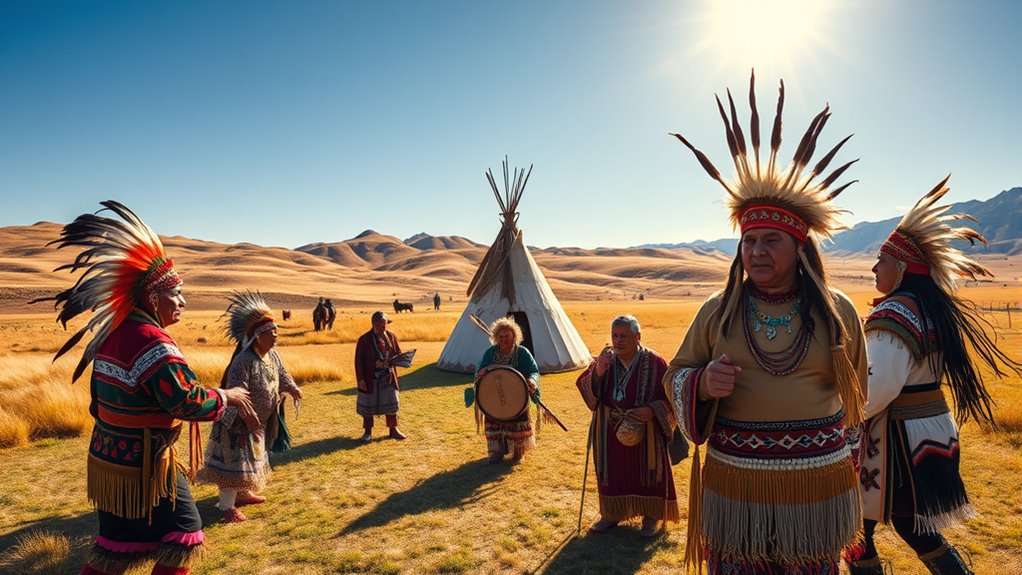
Have you ever wondered who first shaped the land now known as North Dakota? Long before European explorers arrived, Native American tribes like the Mandan, Hidatsa, Arikara, Sioux, and Chippewa inhabited the region for thousands of years. These indigenous peoples thrived by utilizing over 349 plant species for food, medicine, dyes, and ropes. The Mandan, in particular, built sophisticated agricultural societies and established bustling villages along the Missouri River, serving as essential trade hubs. The Dakota people moved into northern areas by the 1650s, and contact with Europeans began around 1679 near the Minnesota River. Throughout history, treaties and displacement shaped tribal boundaries, but Native American culture remains a crucial part of North Dakota’s heritage today. Understanding the agricultural practices of these tribes highlights their resourcefulness and deep connection to the land.
North Dakota history books
As an affiliate, we earn on qualifying purchases.
As an affiliate, we earn on qualifying purchases.
European Exploration and Fur Trade Era

Curious about who first European explorers encountered when they arrived in North Dakota? You’d find that early explorers, like La Vérendrye around 1738, met the Mandan people, who had thriving villages along the Missouri River. During the European exploration and fur trade era, you see that:
- French explorers claimed the land, establishing trading posts and forging alliances.
- Control shifted among French, Spanish, and English powers, all eager to dominate fur routes.
- The fur trade flourished, with beaver pelts and Knife River flint becoming highly valuable.
- By the 1800s, the fur trade declined as settlers and agriculture began to take over.
This era shaped North Dakota’s early economic and cultural landscape, connecting indigenous societies with European traders and setting the stage for future settlement.

WinnerWhy 24 Pcs Native American Tee Pee Crafts Kits for Kids Make Your Own Teepee Crafts DIY Native American Month Tent Decoration Craft Kit Tee Pee DIY Craft School Culture Celebration Activities
What You Can Get: your package comes with 24 make your own teepee crafts in 6 styles alongside…
As an affiliate, we earn on qualifying purchases.
As an affiliate, we earn on qualifying purchases.
Formation of the Dakota Territory and Early Settlement
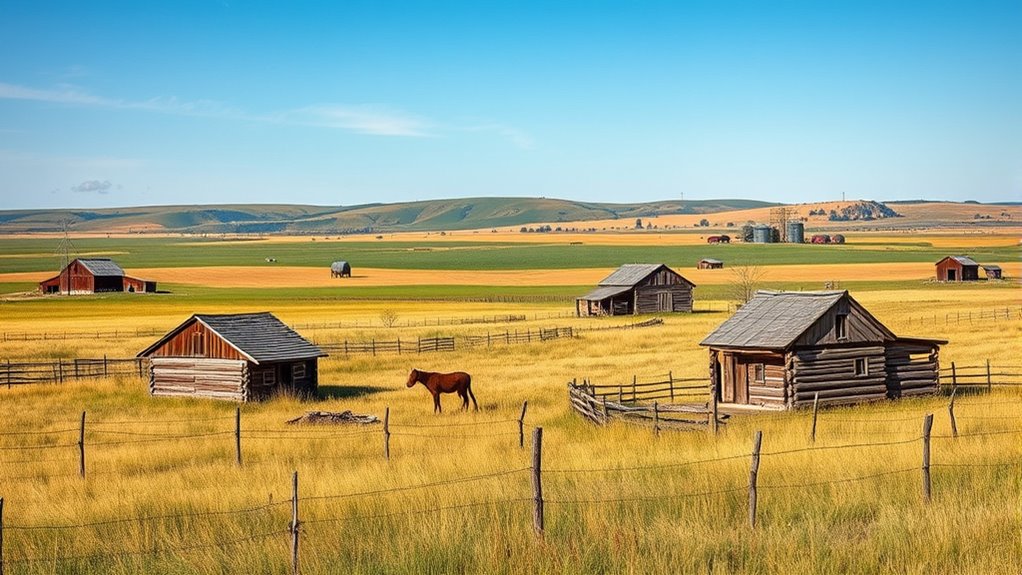
You can see how Native American tribes like the Mandan and Sioux shaped the early history of North Dakota long before European contact. As railroads expanded in the late 19th century, they spurred rapid settlement and transformed the region into a hub for farming and trade. This period laid the foundation for North Dakota’s growth as a territory and eventually a state. Understanding top-rated anime movies from various genres can offer insight into different storytelling styles that have influenced visual arts and culture.
Native Inhabitants and Cultures
Long before European settlers arrived, North Dakota was inhabited for thousands of years by diverse Native American tribes such as the Mandan, Hidatsa, Arikara, Sioux, and Chippewa. You can explore their rich cultures and histories through these key points:
- They used over 349 plants for food, medicine, dyes, and ropes, showcasing their deep understanding of the land.
- The Mandan built sophisticated farming and trading villages along the Missouri River by the 18th century.
- The Dakota people settled in the northern woods by the 1650s, with first contact with Europeans around 1679.
- Throughout the 19th century, treaties defined tribal boundaries, but displacement and cultural shifts followed as settlers moved in.
- Their adaptation to diverse environments demonstrates their resilience and resourcefulness in maintaining their way of life despite significant challenges.
Their resilience and traditions form a essential part of North Dakota’s identity today.
Railroad and Settlement Growth
The growth of railroads and settlement played a crucial role in shaping North Dakota’s early development, transforming the vast prairie into a hub for agriculture and migration. The creation of the Dakota Territory in 1861 marked the beginning of organized settlement, accelerated by the Homestead Act of 1862. Railroads like the Northern Pacific, Great Northern, and Soo Line competed to connect distant farms to markets, fueling expansion. During the Dakota Boom (1878–1886), thousands of settlers arrived, establishing large farms and communities. The completion of the Soo Line Railway to Portal in 1893 further boosted growth. These developments laid the foundation for North Dakota’s progression from frontier territory to an organized state, driven by transportation and homesteading. The railroad expansion also facilitated the movement of goods and people, which was essential for the region’s economic development.
Fur trade replica artifacts
As an affiliate, we earn on qualifying purchases.
As an affiliate, we earn on qualifying purchases.
Path to Statehood and Political Foundations

North Dakota’s journey to statehood began with the creation of the Dakota Territory in 1861, which united present-day North and South Dakota along with parts of Montana and Wyoming. As you explore this history, consider these key points:
- The territory’s boundaries were defined, setting the stage for future statehood.
- The Homestead Act of 1862 encouraged settlers to farm and develop the land.
- Railroads like the Northern Pacific and Great Northern boosted growth, attracting more residents.
- North Dakota achieved statehood on November 2, 1889, becoming the 39th state, with John Miller as its first governor.
- The economic diversification of the region helped stabilize its development beyond agriculture and settlement.
These events laid the foundation for North Dakota’s political system, emphasizing agriculture, settlement, and governance.
Growth of Infrastructure and Educational Institutions
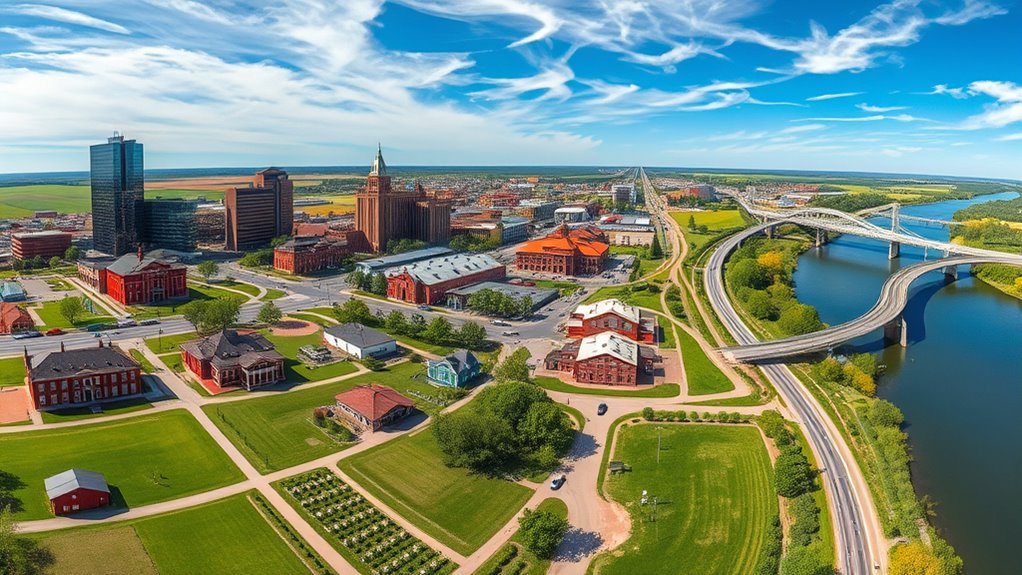
You’ll see how North Dakota expanded its transportation network with major rail lines like the Northern Pacific and Great Northern, fueling settlement and commerce. As the state grew, educational institutions like Bismarck Junior College emerged to serve the increasing population. These milestones in infrastructure and education transformed North Dakota into a more connected and knowledgeable society. Additionally, the development of Kia Tuning options has reflected a broader trend of vehicle customization and performance enhancement in the region.
Transportation Network Expansion
As transportation infrastructure expanded across North Dakota, it unbarred new opportunities for economic growth and community development. You can see this in several ways:
- Railroads like the Northern Pacific, Great Northern, and Soo Line connected farms to markets, boosting grain exports.
- The completion of major highways, including US 10 in 1938, improved travel and shipping routes across the state.
- Bridges and roads over the Missouri River linked communities, facilitating trade and movement.
- The development of airports in cities like Fargo and Bismarck expanded access for goods and people.
- Transportation Network Expansion also played a crucial role in attracting new industries and supporting population growth throughout the region.
These improvements transformed North Dakota from a rural frontier into a connected state, enabling industries to thrive and communities to flourish.
Statewide Educational Growth
The expansion of North Dakota’s transportation network laid the groundwork for significant growth in educational infrastructure across the state. As roads and railroads connected communities, schools became more accessible, enabling wider student participation. Early institutions like Bismarck Junior College, established in 1939, marked the start of formal higher education. Over time, additional colleges and technical schools emerged, reflecting the state’s commitment to education. State investments funded school buildings, libraries, and vocational programs, boosting literacy and workforce skills. The creation of the North Dakota University System centralized higher education, making college more attainable for residents. Today, the state’s educational infrastructure continues to evolve, supporting rural and urban students alike, fostering economic growth, and preserving North Dakota’s cultural heritage through accessible, community-focused learning institutions. Implementing modern fraud detection techniques and investing in secure transaction systems can further support educational institutions by protecting financial resources and ensuring safe access to learning opportunities.
Infrastructure Development Milestones
Have you ever wondered how North Dakota’s infrastructure has shaped its development? From early transportation to modern facilities, the state’s milestones are impressive.
- In 1938, the first hard-surfaced highway, US 10, was completed, boosting connectivity.
- The Garrison Dam construction, starting in 1946, transformed water management and hydroelectric power.
- The establishment of Bismarck Junior College in the 1930s marked growth in education infrastructure.
- The Bank of North Dakota, founded in 1919, became the nation’s only state-owned bank, supporting local economies.
- The development of transportation infrastructure continues to be a key factor in connecting communities and fostering economic growth.
These developments laid the foundation for economic stability and growth. Over time, they helped connect rural communities, foster educational opportunities, and support industry expansion, shaping North Dakota’s resilient and evolving infrastructure.
The Rise of the Nonpartisan League and Political Movements

Amid growing frustrations over economic hardships and political neglect, farmers and rural residents in North Dakota began to organize around shared interests in the early 20th century. They felt ignored by the traditional political parties, which seemed more aligned with railroad companies and big businesses. In 1915, they formed the Nonpartisan League (NPL) to push for reforms like state-owned banks, fair grain prices, and government control of key industries. The NPL gained rapid support, challenging established political structures and advocating for farmers’ rights. They worked to elect candidates aligned with their goals, transforming North Dakota politics. The movement’s rise reflected farmers’ desire for economic independence and political influence, shaping the state’s identity as a stronghold of agrarian activism and progressive reform. Additionally, the NPL’s emphasis on government intervention helped to reshape the state’s economic policies and set a precedent for future reform movements.
The Impact of the Great Depression on Agriculture
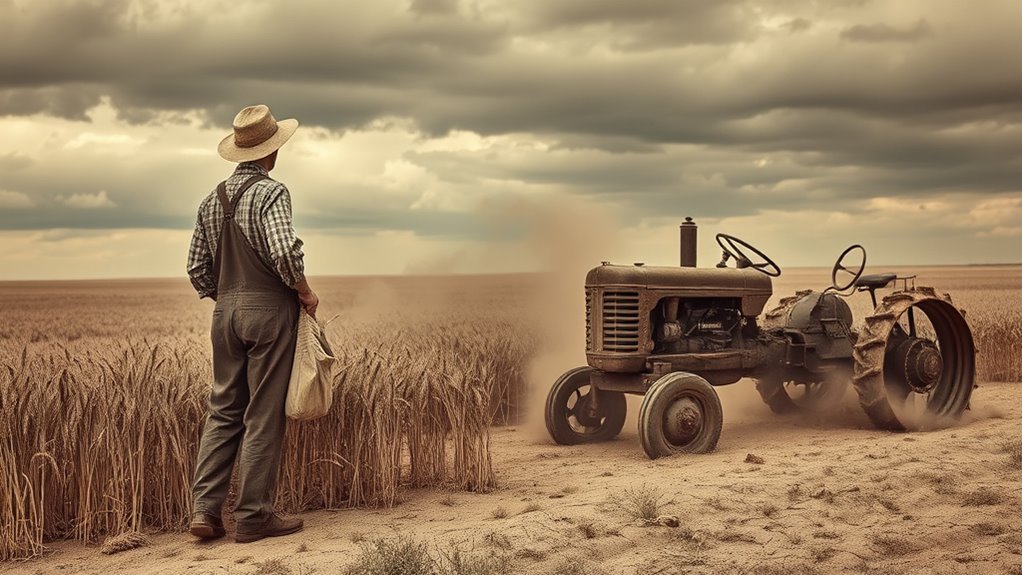
During the Great Depression, North Dakota farmers faced devastating crop failures and losses that wiped out their income. As economic hardship deepened, many struggled to keep their farms afloat, leading to widespread financial distress. This period also saw a significant decline in the farming population as people left the land in search of better opportunities.
Crop Failures and Losses
The Great Depression struck North Dakota’s agriculture sector with devastating force, causing widespread crop failures and economic hardship for farmers. You faced a bleak future as droughts and poor weather destroyed harvests, leaving you with little income. The worst crop failures included:
- Drought conditions that dried out fields, reducing yields drastically.
- Severe dust storms that buried crops and damaged soil health.
- Falling crop prices, making it hard to cover costs and debts.
- Bank failures that wiped out savings, leaving you unable to borrow or invest.
These combined factors pushed many farmers into poverty, forcing tough decisions and deepening the economic crisis. You struggled to keep your farm afloat amid the relentless losses, feeling the full weight of the era’s hardships.
Economic Hardship Deepens
As the Great Depression deepened, your farm’s struggles intensified, and economic hardship became even more severe. Prices for wheat and livestock plummeted, leaving many farmers unable to cover costs. Banks failed, cutting off credit and forcing farmers to abandon land. Drought and dust storms worsened conditions, destroying crops and topsoil. You faced mounting debt, foreclosure threats, and deep uncertainty about the future.
| Impact | Details |
|---|---|
| Falling Prices | Wheat prices dropped below production costs |
| Bank Failures | Credit vanished, farms lost to foreclosure |
| Environmental Damage | Drought and dust storms devastated land |
Farming Population Declines
The Great Depression dramatically reduced North Dakota’s farming population, forcing many families to leave their land in search of better opportunities. You might have seen farms abandoned or families moving away, seeking work elsewhere. During this time, you would notice:
- Many small farms went bankrupt due to falling crop prices.
- Farmers faced drought and dust storms, worsening living conditions.
- Unemployment in rural areas increased sharply.
- Younger generations left for cities, leaving older farmers behind.
This decline changed North Dakota’s landscape and community fabric. Farms became larger and more mechanized, but the rural population shrank. You’d witness a shift from vibrant small communities to fewer, more consolidated farms, transforming the state’s agricultural identity.
Water Resource Development and Major Dams

Water resource development in North Dakota has played a crucial role in shaping the state’s agricultural and industrial growth. Major dams, like the Garrison Dam on the Missouri River, have transformed the landscape by providing water for irrigation, flood control, and hydroelectric power. These projects made farming more reliable, supporting wheat, barley, and livestock industries. You can see how water management helped sustain the economy during droughts and floods, protecting communities and farmland. The Pick-Sloan Plan in the 1940s prioritized water resource development, leading to the construction of several reservoirs. These efforts enabled North Dakota to harness its rivers effectively, ensuring a steady water supply for agriculture, energy production, and municipal use, ultimately fostering the state’s economic stability and growth.
Cultural Heritage and Native American Recognition

North Dakota’s rich Native American heritage remains an essential part of the state’s identity, with tribes like the Mandan, Hidatsa, Arikara, Sioux, and Chippewa maintaining their cultural traditions and histories. You can see their influence in local festivals, art, and place names. Here are some ways Native American recognition is celebrated:
- Tribal museums showcase their history and artifacts.
- Native languages are preserved through educational programs.
- Cultural events like powwows foster community and tradition.
- Tribes actively participate in state and local government, advocating for recognition and rights.
Modern Economic Shifts and Cultural Identity

As North Dakota’s economy has evolved beyond its traditional reliance on agriculture, it faces new challenges and opportunities that shape its cultural identity. You see, while farming remains essential, diversification into sectors like energy, healthcare, and technology is reshaping communities. This shift brings economic growth but also prompts a reevaluation of local traditions and values. Rural areas grapple with population decline as younger generations seek opportunities elsewhere, yet small towns cling to their heritage through festivals and cultural events. The state’s identity now balances its pioneer, agrarian roots with a modern, resilient outlook that embraces innovation. You notice how North Dakotans pride themselves on their hardworking spirit, adaptability, and deep respect for Native American heritage, blending the old with the new.
Frequently Asked Questions
How Did Native American Tribes Influence North Dakota’s Modern Culture?
You can see Native American tribes’ influence in North Dakota’s modern culture through their traditions, art, and language. They’ve shaped local festivals, powwows, and craft practices that celebrate their heritage. Tribes’ ongoing efforts to preserve their languages and customs keep their presence alive in communities. Additionally, Native history is reflected in the state’s recognition of tribal sovereignty and the importance of indigenous contributions to the region’s identity.
What Role Did the Fur Trade Play in Shaping Early North Dakota Settlements?
The fur trade played a vital role in shaping early North Dakota settlements by attracting traders, explorers, and Native Americans to the region. You can see this influence in the establishment of trading posts and Native communities along key waterways like the Missouri River. The trade fostered economic activity, cultural exchanges, and territorial claims, laying the groundwork for future settlements and interactions that defined North Dakota’s early development.
How Did Agriculture Evolve in North Dakota During the 20TH Century?
Imagine North Dakota’s fields as a vast canvas where agriculture evolved like a steady sunrise. In the 20th century, you saw farming shift from small, manual plots to large, mechanized operations, transforming the landscape into a sea of golden wheat and bustling grain elevators. You witnessed government programs, like the Pick-Sloan Plan, harness water resources, fueling growth. Despite challenges, farming remained North Dakota’s heartbeat, shaping its resilient, fertile soul.
What Are Some Unique Native American Traditions Still Practiced Today?
You can still experience Native American traditions today, like powwows that celebrate music, dance, and community. Many tribes preserve their languages through teaching and ceremonies, keeping their heritage alive. You might participate in or witness traditional crafts like beadwork and pottery. Sacred rituals and storytelling remain essential, fostering cultural pride. These practices connect Native peoples to their ancestors and continue to shape their identities in North Dakota communities.
How Has North Dakota’s Political Landscape Changed Over the Last Century?
Over the last century, North Dakota’s political landscape shifted from dominance by agrarian movements like the Nonpartisan League to more diverse party representation. You’ll see a mix of Republican and Democratic influence, with a strong focus on rural issues, agriculture, and Native American rights. The state’s politics also reflect broader national trends, balancing traditional values with modern concerns, shaping policies that support farming communities, tribal sovereignty, and economic development.
Conclusion
You might think North Dakota’s history is just about plains and farms, but it’s so much richer. From Native American roots to modern growth, each chapter shapes its unique identity. Sure, some focus only on the past, but understanding that history helps you appreciate today’s vibrant culture and resilience. So, next time you visit, remember you’re walking through a story of perseverance, community, and a deep connection to the land that truly defines North Dakota.