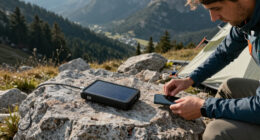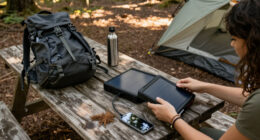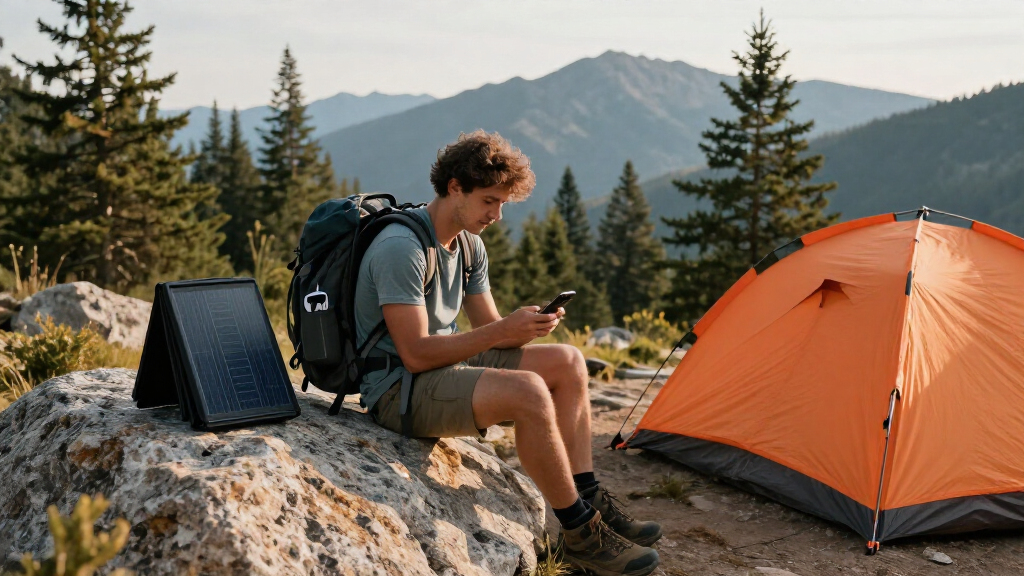

Portable solar power banks sit between an ordinary power bank and a small off-grid power system. The comparison is usually between a compact model that fits easily in a day bag and a larger, high-capacity model intended to keep several devices running on longer trips. The main tradeoff is straightforward: portability versus stored energy. Neither type should be judged by its solar panel alone. Small panels generally recharge these banks slowly, and actual output varies with sunlight, angle, temperature, and shading. Choose compact for a lighter emergency reserve and occasional phone top-ups; choose high capacity when you need more energy ready to use and can carry the extra bulk.

Get travel and outdoor gear delivered free with Prime
- Fast, free delivery on millions of items
- Prime Video, Amazon Music and more included
- Member-only deals all year

SolarTred 20,000mAh Solar Power Bank with Four Panels and Three Built-In Cables
- ✔ Capacity: 20,000mAh
- ✔ Solar panels: 4 integrated panels
- ✔ Ports: 2 USB-A output; 1 USB-C input/output

BLAVOR 20,000mAh Solar Power Bank with Wireless Charging
- ✔ Capacity: 20,000mAh
- ✔ Maximum output: 20W
- ✔ Built-in cables: 4: two USB-C, one iOS, one USB-A

BLAVOR 10,000mAh Solar Power Bank with Wireless Charging
- ✔ Capacity: 10,000mAh
- ✔ USB-C output: 20W
- ✔ Wireless charging: Qi-compatible
At a Glance
| Criteria | Compact portable solar power bank | High-capacity portable solar power bank | Winner |
|---|---|---|---|
| Stored capacity | Lower capacity; best for topping up a phone or keeping a small device available | Higher capacity; stores more energy for repeat phone charging or larger devices | B |
| Portability | Usually lighter and easier to pack in a day bag | Heavier and bulkier, with more space needed in a pack | A |
| Solar recharging | Small built-in panel; useful as a slow trickle charge in strong sunlight | More stored energy does not necessarily mean faster solar charging; panel size and input limits matter | Depends |
| Charging multiple devices | Typically suited to one or two small devices, depending on ports and output | More likely to support several devices or higher output, depending on its specifications | B |
| Durability and weather exposure | Often easier to protect inside a bag; water resistance varies by model | Can suit longer outdoor use, but size does not guarantee weatherproofing | Depends |
| Cost and value | Usually costs less, though features and build quality vary | Costs more; worthwhile when the extra usable capacity replaces other power sources | Depends |
SolarTred 20,000mAh Solar Power Bank with Four Panels and Three Built-In Cables
The SolarTred M5WS is the most balanced choice for a trip where protection and charging flexibility matter as much as battery reserve. Its 20,000mAh capacity matches the larger BLAVOR, but SolarTred stands apart with four integrated solar panels and an IP67 rating. That rating gives it the clearest stated protection against water and dust in this lineup, which makes it a more reassuring companion for rougher outdoor conditions than either IPX5 BLAVOR.Three built-in cables and three ports let us connect common devices without packing as many loose leads, and the product description says it can charge up to five devices simultaneously. The flashlight and adjustable camping light add useful campsite functions, although they cannot run at the same time. At 1.4 pounds, it is substantially heavier than the 9.3-ounce BLAVOR 10,000mAh, so the extra capacity and rugged build come with a real carrying cost.SolarTred is our top pick for people who value capacity, integrated connections and stronger stated protection. Its four panels are a distinctive advantage on paper, but no charging rate is provided; we should still use a wall or vehicle charger as the main way to refill it. For a lighter kit or wireless charging, the BLAVOR options are better aligned.
Pros:
- 20,000mAh capacity and four integrated solar panels
- IP67-rated water and dust resistance
- Three built-in cables and support for up to five devices
- Includes a flashlight and adjustable camping light
Cons:
- At 1.4 pounds, it is the heaviest listed model
- Solar charging speed is not specified
- Flashlight and camping light cannot operate simultaneously
Best for: Campers and outdoor travelers who want a high-capacity bank with built-in cables, lighting and an IP67-rated design.
Not ideal for: Ultralight hikers or buyers who need a documented solar recharge rate or Qi wireless charging.
Bottom line: Choose SolarTred when ruggedness, 20,000mAh capacity and built-in connections outweigh the cost of carrying a 1.4-pound bank.
“Choose SolarTred when ruggedness, 20,000mAh capacity and built-in connections outweigh the cost of carrying a 1.4-pound bank.”
BLAVOR 20,000mAh Solar Power Bank with Wireless Charging
When a group trip means carrying a phone, watch and more than one charging cable, the BLAVOR 20,000mAh offers the broadest mix of connections in this comparison. Four built-in cables cover USB-C, iOS and USB-A devices, and the unit also supports Qi wireless charging for compatible phones and Apple Watch. Compared with SolarTred, it adds wireless charging and a thermometer, but its stated protection is IPX5 rather than IP67.The 20W USB-C output gives us a defined fast-charging capability, while the listed safeguards cover overcharge, over-discharge, over-current and short circuits. Lights, a compass and a carabiner add practical outdoor touches. These extras may help consolidate a kit, though they also mean there are more features to consider than a buyer seeking a straightforward battery needs.Its main limitation is the solar claim: charging is included, but the rate is not specified. We should not expect the built-in solar feature to replace cable charging without better performance details. The smaller BLAVOR is a better choice if lower weight matters more than capacity; SolarTred is preferable where the stronger IP67 rating is the priority.
Pros:
- 20,000mAh capacity with four built-in cables
- 20W USB-C output and Qi wireless charging
- Includes a flashlight, camping light, compass and thermometer
- Built-in electrical protection features
Cons:
- Solar charging speed is not specified
- IPX5 protection is less comprehensive on paper than SolarTred’s IP67
- Wireless charging requires a compatible device
Best for: Travelers carrying a mix of USB-C, iOS and wireless-chargeable devices who want 20,000mAh of reserve.
Not ideal for: Buyers who need a stated solar recharge rate, a lighter high-capacity bank or IP67 protection.
Bottom line: Pick this BLAVOR when cable variety and wireless charging for a mixed-device kit matter more than a documented solar rate or top protection rating.
“Pick this BLAVOR when cable variety and wireless charging for a mixed-device kit matter more than a documented solar rate or top protection rating.”
BLAVOR 10,000mAh Solar Power Bank with Wireless Charging
The BLAVOR 10,000mAh makes the most sense when we want outdoor-friendly features in a smaller, lighter package. At 9.3 ounces, it is the lightest option with a stated weight here, and its 5.91 × 3.07 × 0.87-inch shape is notably thinner than the 20,000mAh BLAVOR. Qi charging is useful when we want to top up a compatible phone without reaching for a cable; 20W USB-C gives us a wired fast-charging alternative.Its capacity is half that of the two larger banks, so we trade reserve for portability. That makes it a more natural fit for a day out or a phone-focused emergency kit than a multi-day trip with several devices. It can charge up to three devices at once, but the supplied details do not specify solar charging performance. The 20,000mAh BLAVOR offers more capacity and four built-in cables, while SolarTred provides a higher stated protection rating.BLAVOR lists IPX5 water resistance and describes the body as dustproof and shockproof, along with dual flashlights and a compass carabiner. The supplied protection detail is less specific than SolarTred’s IP67 rating, and 9.3 ounces may still feel bulky to someone choosing the smallest possible backup. This is the lineup’s compact-role pick, not a minimal-weight power bank.
Pros:
- Lightest listed option at 9.3 ounces
- Qi wireless charging plus 20W USB-C output
- Can charge up to three devices simultaneously
- Includes dual flashlights and a compass carabiner
Cons:
- 10,000mAh capacity is half that of the two larger models
- Solar charging performance is not specified
- IPX5 rating is below SolarTred’s stated IP67 protection
Best for: Day hikers and travelers who want Qi wireless charging and outdoor features without carrying a 20,000mAh unit.
Not ideal for: Multi-day users who need more reserve, or buyers who want four integrated panels or a clearly specified solar input rate.
Bottom line: Choose the 10,000mAh BLAVOR for a lighter day-trip kit where Qi charging and a smaller battery are a better match than maximum reserve.
“Choose the 10,000mAh BLAVOR for a lighter day-trip kit where Qi charging and a smaller battery are a better match than maximum reserve.”
As an Amazon Associate we earn from qualifying purchases.
Key Differences
Capacity sets how much energy is available before the bank itself needs recharging. A compact model makes sense when the goal is one emergency phone top-up or a little extra battery during a day out. A high-capacity model gives more headroom for repeated charging, multiple users, or devices with larger batteries. The printed capacity is not the same as energy delivered to a device: conversion losses and the power bank’s own operating needs reduce what reaches a phone. Compare tested or clearly specified output as well as the headline capacity.
Solar charging is the most commonly misunderstood feature. A panel integrated into a portable bank is usually small, so it may add charge gradually under sustained, direct sunlight rather than refill a depleted bank quickly. A larger battery can take longer to refill from such a panel, not less. If solar replenishment is central to your plans, compare the panel’s rated output, solar input limits, and charging time under stated conditions. For dependable charging, treat the built-in panel as a supplement and plan another charging method when available.
The practical choice comes down to how much stored energy you need to carry. Compact banks win on convenience and are more likely to be on hand when a phone runs low. Larger banks win when repeated charging matters enough to justify the weight and price. Features such as ports, charging speed, and water resistance vary across products in both groups, so check the individual model rather than assuming size guarantees capability.
Detailed Comparison
Stored capacity (High-capacity portable solar power bank wins — major)
The high-capacity bank wins by definition: it holds more energy, which can support repeat charging or a mix of devices. That is a major difference on a multiday trip or when several people share one bank. For a short outing with a phone as the only device, the additional stored energy may sit unused, making compact capacity the more sensible fit.
Portability (Compact portable solar power bank wins — major)
The compact bank wins because lower size and weight make it easier to carry every day and more convenient to reach in an emergency. This is a moderate-to-major advantage for walking, commuting, and light packing. A larger bank is still portable, but its extra weight only pays off when the additional capacity is likely to be used.
Solar recharging (moderate difference)
Neither category wins automatically. A high-capacity model may store more energy without having a stronger panel; the panel’s size, rated output, and compatible solar input determine how quickly sunlight can replenish it. This is a moderate practical difference between specific products, but often a minor distinction between capacity categories. Check measured charging expectations and treat an integrated panel as a slow supplement.
Charging multiple devices (High-capacity portable solar power bank wins — moderate)
High-capacity models are more likely to provide the energy and ports for charging several devices, giving them a moderate advantage for groups and longer trips. But capacity alone does not establish how many devices can charge at once or how quickly. Check the port count, output ratings, and whether simultaneous charging reduces speed. A compact bank remains adequate for one phone and occasional small-device use.
Durability and weather exposure (moderate difference)
There is no category-wide winner. A compact bank may be simpler to stow safely, while a larger outdoor-oriented model may offer stronger casing or water resistance. Those are product-specific choices, not reliable consequences of capacity. The gap is moderate for camping or wet-weather use: look for a stated protection rating, covered ports, and construction details rather than relying on labels such as rugged or solar.
Cost and value (moderate difference)
Compact banks usually cost less upfront, which makes them better value for occasional backup. High capacity earns its premium when it replaces carrying multiple banks or when access to outlets is limited. Compare price per usable capacity, charging outputs, warranty, and weight together. Paying more for capacity that will rarely be used is poor value; paying more to avoid running out on a long trip can be reasonable.
Compact portable solar power bank: Pros and Cons
Pros:
- Lighter and easier to carry routinely
- Lower upfront cost for basic backup
- Convenient for a phone top-up or small emergency reserve
Cons:
- Less stored energy for repeat charges
- May not suit groups or higher-draw devices
- Built-in solar charging is generally slow and limited
High-capacity portable solar power bank: Pros and Cons
Pros:
- More stored energy for longer outings and repeat charging
- Better suited to sharing across multiple devices, if ports support it
- Can reduce the need to carry several smaller banks
Cons:
- Heavier and bulkier in a day pack
- Higher purchase price
- A small integrated panel can take a long time to replenish its larger battery
Who Should Choose What
Choose Compact portable solar power bank if:
- You want a light backup for commuting, day hikes, or travel days.
- Your main need is an occasional phone top-up rather than repeated charging.
- You prefer a lower-cost bank that is easy to keep in a small bag.
Choose High-capacity portable solar power bank if:
- You expect to recharge a phone several times or support multiple people.
- You are taking a longer trip with limited access to wall outlets.
- You can accept extra weight in exchange for more energy already stored.
Skip both if: You need reliable power for laptops, appliances, or sustained off-grid use. Compare a power station or a separate, appropriately sized solar panel and battery system instead.
Value for Money
Paying more for a high-capacity bank is worthwhile when you will use the stored energy: multiday travel, several devices, or limited access to outlets. In that situation, the extra capacity can be more practical than carrying multiple compact banks. For routine phone backup, the compact option is usually better value because it costs less and is more convenient to carry. Do not pay a premium on the assumption that a larger battery will charge faster from its built-in panel. Check solar input ratings and realistic recharge times; buy for stored capacity first and solar performance only when the product specifications support your use.
Final Verdict
For most people who want a bank to carry every day, choose the compact model. Its lower weight and cost make it more likely to be useful, and it can handle the common job of keeping a phone alive through a day. Choose the high-capacity model if you routinely need repeat charges, share power, or travel beyond easy access to outlets; the additional bulk is justified by energy you will actually use. The deciding factor is how much stored power your trip requires, not the presence of a solar panel. If you expect solar to be your main energy source, compare panel output and recharge conditions carefully or consider a separate panel system.
Frequently Asked Questions
Can a portable solar power bank recharge itself fully in sunlight?
It depends on the panel size, battery capacity, sunlight, orientation, and shading. Many integrated panels are small and work best as a slow supplement. A larger bank can take longer to refill if the panel does not provide substantially more power.
Is a high-capacity solar power bank worth the extra cost?
Yes, if you need repeated charges, share the bank, or will be away from outlets for an extended period. For occasional phone backup, the compact option usually provides better value because it weighs less and costs less.
Does a larger power bank charge devices faster?
Not necessarily. Capacity indicates how much energy the bank stores. Charging speed depends on the output rating of its ports, the cable, and the device. Check the model’s specified output before buying.
What should I check before buying one for hiking?
Compare weight, usable capacity, port output, charging time, and stated water or dust protection. For a short hike, a compact bank is often enough. For a multiday route, more stored capacity can help, but do not count on a small integrated panel to rapidly refill it.