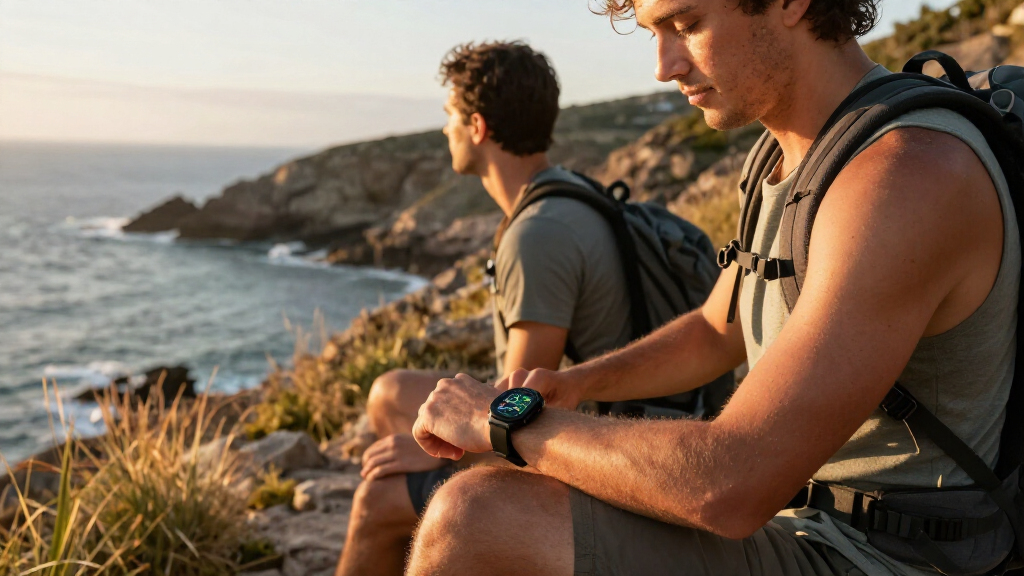
For most travelers, I’d start with the Garmin vívoactive 5: it pairs GPS and fitness features with a more travel-ready balance of daily usability than basic call-focused watches. The Garmin Instinct E is a stronger fit for outdoor trips, while the Amazfit Bip 6 stands out for travelers who want a large AMOLED screen and built-in GPS. The main tradeoffs are navigation and activity features versus simple convenience, along with watch size, battery demands, and how much you want to depend on a phone. Read on for the full breakdown of all 14 travel smartwatches and which type of traveler each suits.

Get travel and outdoor gear delivered free with Prime
- Fast, free delivery on millions of items
- Prime Video, Amazon Music and more included
- Member-only deals all year
Complete the kit


Key Takeaways
- The Garmin vívoactive 5 is the most balanced travel pick in this lineup, combining built-in GPS with fitness-focused features without leaning as heavily toward rugged bulk as the Instinct E.
- The Instinct E is the outdoor specialist: its rugged design better suits demanding trips, while the sleeker Garmin Lily 2 prioritizes a smaller, more understated profile.
- Built-in GPS separates trip-ready activity tracking from phone-dependent convenience. Several budget-oriented models emphasize calls, screens, and sports modes, but those features do not replace independent location tracking.
- Amazfit offers distinct screen and size choices: the Bip 6 favors a large display, while the Active 3 Premium and Active Max offer different compact-screen and storage-focused directions.
- Many lower-cost listings emphasize call support and activity counts, but travelers should verify GPS, water resistance, and offline-use needs rather than treating those headline features as substitutes.
| Garmin vívoactive 5 GPS Fitness Smartwatch, 42 mm, Ivory |  | Best Overall for Travel | Display: AMOLED touchscreen | Case size: 42 mm | GPS: Built-in | VIEW LATEST PRICE | See Our Full Breakdown |
| Bakoor C60 Fitness Tracker with 1.1-Inch AMOLED Display |  | Best Simple, Phone-Connected Pick | Display: 1.1-inch AMOLED touchscreen | Sports modes: 25 | GPS: Connected GPS | VIEW LATEST PRICE | See Our Full Breakdown |
| aeac Smartwatch for Women with 1.32-Inch AMOLED Display |  | Best for Calls and a Dressier Travel Look | Display: 1.32-inch AMOLED touchscreen | Case size: 43 mm | Case and band: Rose gold; metal band | VIEW LATEST PRICE | See Our Full Breakdown |
| AEAC Smartwatch for Women with 1.85-Inch HD Display and Two Bands |  | Best Large-Screen Travel Companion | Display: 1.85-inch HD touchscreen, 60 Hz | Connectivity: Bluetooth 5.3 | GPS: Via smartphone | VIEW LATEST PRICE | See Our Full Breakdown |
| Smartwatch with 1.85-inch HD AMOLED Curved Display, AI Dial & Q&A, Bluetooth Calls, Health Monitoring, 120+ Sports Modes, IP68 Waterproof – Deep Black |  | Best for Screen Features and Customization | Display: 1.85-inch curved AMOLED HD, 390 x 450 resolution | Battery: 230 mAh; up to 7 days active use | Standby time: Up to 30 days | VIEW LATEST PRICE | See Our Full Breakdown |
| Garmin Instinct E Rugged GPS Smartwatch 45mm Charcoal |  | Best for Remote Outdoor Trips | Case size: 45 mm | Battery life: Up to 16 days | Water resistance: 10 ATM (100 meters) | VIEW LATEST PRICE | See Our Full Breakdown |
| Amazfit Bip 6 Smartwatch with 1.97-Inch AMOLED Display and GPS |  | Best Value for Map-Friendly Travel | Display: 1.97-inch AMOLED | GPS: Built-in; GPS, BeiDou, GLONASS, and Galileo | Battery life: Up to 14 days | VIEW LATEST PRICE | See Our Full Breakdown |
| TG08 Smartwatch with 1.83-Inch Display, 120 Sports Modes, Bluetooth Calling, and Health Tracking |  | Best for Basic Phone-Connected Travel | Display: 1.83-inch IPS, 240 × 284 resolution | Sports modes: 120 | GPS: Via smartphone | VIEW LATEST PRICE | See Our Full Breakdown |
| Garmin Lily 2 Smartwatch, 35 mm, Coconut |  | Best Compact Travel Watch | Case size: 35 mm | Weight: 0.8 ounces | Case and band: Metal case; silicone band | VIEW LATEST PRICE | See Our Full Breakdown |
| Aeac Smartwatch with Bluetooth Calling and Alexa, 1.85-Inch Display, Fitness and Sleep Tracking, 120+ Sport Modes, 3ATM Water Resistance |  | Best for Voice-Assisted Everyday Travel | Display: 1.85-inch HD touchscreen | Compatibility: iOS and Android | Connectivity: Bluetooth | VIEW LATEST PRICE | See Our Full Breakdown |
| Amazfit Active 3 Premium GPS Smartwatch with 1.32-Inch AMOLED Display |  | Best for Offline Navigation | Display: 1.32-inch AMOLED, 390 x 390 resolution, up to 3,000 nits | Materials: Stainless steel case, sapphire glass, silicone band | Operating system: Zepp OS | VIEW LATEST PRICE | See Our Full Breakdown |
| Jugeman Smartwatch for Women with AMOLED Display, Health Tracking, Bluetooth Calling, and IP68 Water Resistance |  | Best for Everyday Travel Basics | Display: 1.32-inch AMOLED with customizable faces and Always-On functionality | Band: Stainless steel | Water resistance: IP68; listed depth of 1 meter | VIEW LATEST PRICE | See Our Full Breakdown |
| Smartwatch for Men with Built-In GPS, 1.46-Inch HD Touchscreen |  | Best for Outdoor Sensor Variety | Display: 1.46-inch HD touchscreen | GPS: Built-in | Outdoor sensors: Compass, altimeter, and barometer | VIEW LATEST PRICE | See Our Full Breakdown |
| Amazfit Active Max Smartwatch, 1.5-Inch AMOLED Display, GPS, 4GB Storage |  | Best for Long Trips Between Charges | Display: 1.5-inch AMOLED, up to 3,000 nits | Battery life: Up to 25 days | Storage: 4GB | VIEW LATEST PRICE | See Our Full Breakdown |
| travel smartwatch | Display | GPS | Battery life | Water resistance |
|---|---|---|---|---|
| Garmin vívoactive 5 GPS Fitnes | AMOLED touchscreen | Built-in | Up to 11 days in smartwatch mode; up to 5 days with always-on display | 50 meters |
| Bakoor C60 Fitness Tracker wit | 1.1-inch AMOLED touchscreen | Connected GPS | Up to 7 days | IP68 |
| aeac Smartwatch for Women with | 1.32-inch AMOLED touchscreen | Via smartphone | Up to 10 days | 3ATM |
| AEAC Smartwatch for Women with | 1.85-inch HD touchscreen, 60 Hz | Via smartphone | Up to 7 days | IP68 |
| Smartwatch with 1.85-inch HD A | 1.85-inch curved AMOLED HD, 390 x 450 resolution | No built-in GPS; relies on phone for location tracking | — | IP68 |
| Garmin Instinct E Rugged GPS S | — | — | Up to 16 days | 10 ATM (100 meters) |
| Amazfit Bip 6 Smartwatch with | 1.97-inch AMOLED | Built-in; GPS, BeiDou, GLONASS, and Galileo | Up to 14 days | 50 meters |
| TG08 Smartwatch with 1.83-Inch | 1.83-inch IPS, 240 × 284 resolution | Via smartphone | 5–7 days active use; up to 30 days standby | IP67; listed depth 1 meter |
| Garmin Lily 2 Smartwatch | Touchscreen beneath a patterned lens | Connected GPS via a compatible smartphone | Up to 5 days | — |
| Aeac Smartwatch with Bluetooth | 1.85-inch HD touchscreen | Via smartphone | 10–12 days with regular use | 3 ATM; stated depth 30 meters |
| Amazfit Active 3 Premium GPS S | 1.32-inch AMOLED, 390 x 390 resolution, up to 3,000 nits | Built-in GPS with six satellite systems | Up to 12 days typical use; up to 7 days heavy use; 24 hours continuous GPS | 50 meters |
| Jugeman Smartwatch for Women w | 1.32-inch AMOLED with customizable faces and Always-On functionality | Via connected smartphone | Up to 7 days | IP68; listed depth of 1 meter |
| Smartwatch for Men with Built- | 1.46-inch HD touchscreen | Built-in | Up to 7+ days with Bluetooth calling enabled | 30 meters (3ATM) |
| Amazfit Active Max Smartwatch | 1.5-inch AMOLED, up to 3,000 nits | Built-in; supports BeiDou, GLONASS, GPS, Galileo, and an unspecified fifth system | Up to 25 days | 50 meters |
More Details on Our Top Picks
Garmin vívoactive 5 GPS Fitness Smartwatch, 42 mm, Ivory
The Garmin vívoactive 5 is my strongest travel pick here for people who want useful fitness tools without planning every day around charging. Its built-in GPS records routes without a phone, a practical advantage over the aeac AR-01 and the other phone-connected GPS options in this group. Up to 11 days in smartwatch mode also makes it better suited to longer trips than watches rated for about a week, though that falls to up to five days with the always-on display enabled. The AMOLED screen, onboard music, Garmin Pay, and broad activity support add convenience for workouts and airport routines. Its 42 mm case and detailed health metrics may be more than a casual traveler needs, and those metrics are estimates rather than medical measurements.
Pros:- Built-in GPS records activities without relying on a phone
- Up to 11 days of smartwatch-mode battery life with the display not always on
- More than 30 sports apps, including wheelchair activities
- On-watch music storage and Garmin Pay reduce reliance on a phone during outings
Cons:- Always-on display use reduces listed battery life to up to five days
- Health metrics are estimates and should not be treated as medical readings
Best for: Travelers who want independent route tracking, workout variety, and fewer charging stops on multi-day trips
Not ideal for: Casual travelers who mainly want notifications and a simple timepiece, or buyers who need always-on display use to last close to the full battery estimate
- Display:AMOLED touchscreen
- Case size:42 mm
- GPS:Built-in
- Battery life:Up to 11 days in smartwatch mode; up to 5 days with always-on display
- Water resistance:50 meters
- Sports apps:More than 30
- Music:On-watch storage with compatible streaming services
- Payments:Garmin Pay
Our verdict“Choose the vívoactive 5 if independent GPS and longer battery life matter more to your travel routine than a basic notification-focused watch.”
Bakoor C60 Fitness Tracker with 1.1-Inch AMOLED Display
The Bakoor C60 suits travelers who want a compact tracker for everyday movement, sleep, and notifications rather than a full-featured navigation watch. Its connected GPS can log workout routes when paired with a compatible phone, but that means it cannot match the phone-free route recording of the Garmin vívoactive 5. The 1.1-inch AMOLED screen keeps the watch relatively small, while up to seven days of battery life is workable for shorter trips. Twenty-five sports modes cover common activities, and IP68 water resistance adds everyday protection; neither detail turns it into a dedicated outdoor navigation tool. I would treat its health readings as reference information, as the product data advises. The listed lack of warranty is a meaningful concern for buyers who want support beyond the trip.
Pros:- Compact 1.1-inch AMOLED touchscreen
- Connected GPS provides route tracking when paired with a compatible smartphone
- Up to seven days of listed battery life
- IP68 water resistance and 25 sports modes
Cons:- GPS and app features depend on a compatible smartphone
- Health measurements are for reference only
- Product data lists no warranty
Best for: Travelers who already carry a compatible phone and want a small, straightforward tracker for daily activity and notifications
Not ideal for: Hikers or runners who need built-in GPS, or buyers who require a stated warranty and stronger support assurances
- Display:1.1-inch AMOLED touchscreen
- Sports modes:25
- GPS:Connected GPS
- Battery life:Up to 7 days
- Standby time:Up to 15 days
- Water resistance:IP68
- Compatibility:Android 5.0 or later; iOS 9.0 or later
Our verdict“Pick the C60 for basic travel tracking with a phone in your pocket, but choose the Garmin vívoactive 5 if you need independent GPS.”
aeac Smartwatch for Women with 1.32-Inch AMOLED Display
For travelers who want a more polished-looking watch that can also handle calls, the aeac AR-01 takes a different approach from the fitness-first Garmin vívoactive 5. It pairs a rose gold case and metal band with Bluetooth calling, voice commands, and a 1.32-inch AMOLED display, making it suited to city breaks and daily wear. Its 110-plus sports modes offer more listed activity choices than the C60, but quantity does not replace independent location tracking: GPS relies on a connected smartphone. Up to 10 days of battery life is a useful advantage for trips, though actual endurance can vary with calling and other use. The 3ATM water resistance is more limited than the vívoactive 5’s 50-meter rating, so I would not choose this for regular swimming or water-heavy travel.
Pros:- Rose gold finish and metal band offer a dressier alternative to silicone travel watches
- Bluetooth calling and voice assistant support
- More than 110 sports modes
- Up to 10 days of listed battery life
Cons:- GPS tracking requires a connected smartphone
- 3ATM water resistance is less suited to swimming than the Garmin vívoactive 5’s 50-meter rating
- The metal band may be less comfortable for sweaty workouts than a silicone strap
Best for: Travelers seeking a dressier rose gold smartwatch with Bluetooth calls, broad activity options, and smartphone-based route tracking
Not ideal for: Outdoor travelers who want phone-free GPS or people planning frequent swimming and water activities
- Display:1.32-inch AMOLED touchscreen
- Case size:43 mm
- Case and band:Rose gold; metal band
- GPS:Via smartphone
- Battery life:Up to 10 days
- Sports modes:110+
- Water resistance:3ATM
- Compatibility:Android 6.0+ and iOS 9.0+
Our verdict“Choose the AR-01 for calls and a dressier look on city trips, not for independent navigation or frequent water activities.”
AEAC Smartwatch for Women with 1.85-Inch HD Display and Two Bands
The AEAC 1.85-inch smartwatch is the easier pick for travelers who want a large screen for glancing at notifications and taking calls, rather than a compact watch built around route recording. Its Bluetooth calling and app alerts can help keep a phone tucked away, but messages cannot be answered from the watch. GPS operates through a smartphone, so the Garmin vívoactive 5 is the stronger choice for phone-free walks or runs. More than 100 sport modes and health tracking give it flexibility for ordinary workouts, while the two included bands make it easier to change the look for different settings. Up to seven days of battery life is serviceable, but the large display and phone-dependent features mean this is not the most self-contained travel option.
Pros:- Large 1.85-inch HD touchscreen for viewing alerts
- Can make and answer Bluetooth calls
- Includes two bands for changing the look
- More than 100 sport modes and IP68 water resistance
Cons:- GPS relies on a connected smartphone
- Messages can be viewed but not replied to from the watch
- Up to seven days of battery life is shorter than the Garmin vívoactive 5’s listed smartwatch-mode estimate
Best for: Travelers who prefer a large, readable screen for calls and alerts and value having two bands for different occasions
Not ideal for: Travelers who need standalone GPS, message replies from the wrist, or a smaller watch for all-day comfort
- Display:1.85-inch HD touchscreen, 60 Hz
- Connectivity:Bluetooth 5.3
- GPS:Via smartphone
- Battery life:Up to 7 days
- Sport modes:More than 100
- Water resistance:IP68
- Included bands:2
- Compatibility:Android 6.0+ and iOS 9.0+
Our verdict“Choose this AEAC model for a large screen, wrist-based calls, and band flexibility, but skip it if independent GPS is a travel priority.”
Smartwatch with 1.85-inch HD AMOLED Curved Display, AI Dial & Q&A, Bluetooth Calls, Health Monitoring, 120+ Sports Modes, IP68 Waterproof – Deep Black
This 1.85-inch curved AMOLED smartwatch is aimed at travelers who care more about an expressive display and extra watch-face features than mapping a route from the wrist. Its AI dial customization and Q&A set it apart from the AEAC 1.85-inch model, which focuses on calls, notifications, and interchangeable bands. Both rely on a phone for location tracking, so neither replaces the Garmin vívoactive 5 when a trip calls for phone-free GPS. The 120-plus sports modes and health monitoring cover a broad range of routine tracking, and IP68 protection suits everyday exposure to water. The listed seven days of active use is reasonable, but the 230 mAh battery and heavy-use charging caveat make it less appealing for travelers who use calls and display features constantly.
Pros:- 1.85-inch curved AMOLED display with 390 x 450 resolution
- AI-assisted dial customization and Q&A features
- More than 120 sports modes and multiple health tracking metrics
- IP68 water resistance and up to seven days of active-use battery life
Cons:- No built-in GPS; location tracking relies on a phone
- 230 mAh battery may need more frequent charging with heavy use
- The large display may not suit travelers seeking a discreet, compact watch
Best for: Travelers who want a large curved AMOLED screen, customizable watch faces, and phone-connected activity tracking
Not ideal for: Travelers who need built-in GPS or expect long active use between charges while using calls and display features heavily
- Display:1.85-inch curved AMOLED HD, 390 x 450 resolution
- Battery:230 mAh; up to 7 days active use
- Standby time:Up to 30 days
- GPS:No built-in GPS; relies on phone for location tracking
- Sports modes:120+
- Water resistance:IP68
- Connectivity:Bluetooth 5.0
- Compatibility:Android 4.0+ and iOS 8.0+
Our verdict“Choose this model for its large customizable AMOLED display and broad activity modes, but choose the Garmin vívoactive 5 for standalone GPS and longer listed battery life.”
Garmin Instinct E Rugged GPS Smartwatch 45mm Charcoal
The Garmin Instinct E is the travel pick I’d favor for rugged routes where a phone may be tucked away and charging outlets are scarce. Its multi-GNSS navigation, compass, and barometric altimeter offer more useful outdoor orientation tools than the Garmin Lily 2, whose GPS depends on a paired phone. Up to 16 days of battery life and 10 ATM water resistance also suit longer, rougher trips. The tradeoff is a deliberately utilitarian interface: there’s no touchscreen, so interactions rely on buttons, and its 45 mm case is more substantial than the Lily 2’s compact 35 mm design. Choose this for durability and navigation, not for a discreet travel accessory or polished touchscreen convenience.
Pros:- Multi-GNSS navigation, compass, and barometric altimeter support outdoor route awareness.
- Up to 16 days of battery life reduces dependence on charging access.
- 10 ATM water resistance and MIL-STD-810 construction suit demanding outdoor travel.
- Tracks heart rate and advanced sleep, with Pulse Ox available in some regions.
Cons:- No touchscreen, making interactions less direct than on touchscreen models such as the Garmin Lily 2.
- Its 45 mm rugged case is bulkier than compact travel watches.
- Pulse Ox availability depends on region.
Best for: Hikers and active travelers who want rugged construction, onboard multi-GNSS navigation, and fewer charging stops.
Not ideal for: Travelers who prioritize a small, dress-friendly watch or easy touchscreen interaction; the 45 mm case and button-only controls may feel cumbersome.
- Case size:45 mm
- Battery life:Up to 16 days
- Water resistance:10 ATM (100 meters)
- Durability:MIL-STD-810
- Navigation:Multi-GNSS (GPS)
- Sensors:Heart rate, advanced sleep monitoring, Pulse Ox (region dependent), barometric altimeter, 3-axis compass
- Case and band:Fiber-reinforced polymer case; silicone band
- Connectivity:Bluetooth, USB, Wi-Fi
Our verdict“Choose the Instinct E for rugged, off-grid travel and long battery life; skip it if compact styling or touchscreen controls matter more.”
Amazfit Bip 6 Smartwatch with 1.97-Inch AMOLED Display and GPS
The Amazfit Bip 6 makes a strong case for travelers who want a bright, roomy screen and onboard GPS without moving up to a rugged specialist such as the Garmin Instinct E. Its 1.97-inch AMOLED display gives maps, directions, and notifications more space, while built-in support for GPS, BeiDou, GLONASS, and Galileo avoids the phone-dependent tracking used by the Garmin Lily 2. Downloadable maps, more than 140 workout modes, and up to 14 days of battery life add practical range for varied itineraries. The compromises are less adventure-focused durability than the Instinct E’s 10 ATM, MIL-STD-810 build and a large watch face that may feel oversized on smaller wrists. It’s a versatile travel companion, not the toughest option here.
Pros:- Large 1.97-inch AMOLED display provides ample room for travel information and map viewing.
- Built-in multi-system GPS works without relying on a phone for positioning.
- Up to 14 days of battery life is well suited to trips with limited charging access.
- More than 140 workout modes and continuous health metrics cover varied routines.
Cons:- 50-meter water resistance is less than the Garmin Instinct E’s 10 ATM rating.
- The large display and case may not suit smaller wrists or travelers seeking a discreet watch.
- Compatibility requires Android 7.0 or later or iOS 14.0 or later.
Best for: Travelers who want a large, readable AMOLED screen, onboard GPS, downloadable maps, and broad activity tracking in one watch.
Not ideal for: Hikers or water-sports travelers who need the tougher 10 ATM, MIL-STD-810 construction of the Garmin Instinct E, or anyone seeking a compact watch.
- Display:1.97-inch AMOLED
- GPS:Built-in; GPS, BeiDou, GLONASS, and Galileo
- Battery life:Up to 14 days
- Water resistance:50 meters
- Workout modes:More than 140
- Health metrics:Heart rate, blood oxygen, sleep, stress, breath rate, calories burned
- Case and band:Aluminum case; silicone band
- Compatibility:Android 7.0+ and iOS 14.0+
Our verdict“Pick the Bip 6 for onboard mapping and a large, bright screen at the center of your travel routine, but choose the Instinct E for tougher conditions.”
TG08 Smartwatch with 1.83-Inch Display, 120 Sports Modes, Bluetooth Calling, and Health Tracking
The TG08 is aimed at travelers who want everyday phone convenience—calls, notifications, music controls, and a way to trigger a phone camera—rather than independent navigation. Its Bluetooth calling and broad phone compatibility make it more communication-focused than the Garmin Instinct E, but its GPS comes from the smartphone, so it cannot replace a phone for location tracking. The 1.83-inch screen and 120 sports modes cover routine use, while the stated five to seven days of active-use battery life is more modest than the Amazfit Bip 6’s up-to-14-day claim. IP67 protection also calls for more restraint around water than either Garmin’s 10 ATM rating or the Bip 6’s 50-meter rating. This is a basic connected companion, not a travel navigation tool.
Pros:- Bluetooth calling and notifications keep common phone functions close at hand.
- Music and camera controls can be handy when the phone is being used for photos or audio.
- Tracks heart rate and sleep alongside 120 sports modes.
- Supports iOS 9.0+ and Android 5.0+, including older phone software than the Amazfit Bip 6 requires.
Cons:- GPS depends on a connected smartphone, unlike the built-in GPS on the Amazfit Bip 6.
- IP67 water resistance is less suited to water-heavy travel than the Garmin Instinct E’s 10 ATM rating.
- The plastic case and five-to-seven-day active-use battery claim are less travel-ready than the more rugged, longer-lasting options.
Best for: Budget-conscious travelers who mainly want phone notifications, Bluetooth calls, and basic activity tracking while carrying their smartphone.
Not ideal for: Independent hikers and travelers who need built-in GPS, stronger water resistance, or extended battery life away from a charger.
- Display:1.83-inch IPS, 240 × 284 resolution
- Sports modes:120
- GPS:Via smartphone
- Battery life:5–7 days active use; up to 30 days standby
- Battery capacity:350 mAh
- Water resistance:IP67; listed depth 1 meter
- Connectivity:Bluetooth calling and notifications
- Compatibility:iOS 9.0+ and Android 5.0+
Our verdict“Choose the TG08 for calls and basic tracking alongside a phone, not for phone-free navigation or extended outdoor trips.”
Garmin Lily 2 Smartwatch, 35 mm, Coconut
For travelers who want a watch that sits quietly under a sleeve or pairs with everyday outfits, the Garmin Lily 2 is the most compact choice in this group. Its 35 mm metal case and 0.8-ounce weight contrast with the larger Amazfit Bip 6 and rugged 45 mm Garmin Instinct E, making it less imposing for all-day wear. Health tracking includes sleep, stress, Body Battery, menstrual cycle, and pregnancy features, while LiveTrack and incident detection add phone-connected safety options. The main travel compromise is connected GPS: route tracking depends on a compatible phone, unlike the Bip 6’s built-in GPS. Up to five days of battery life also means more frequent charging than the Garmin Instinct E or Bip 6. I’d pick it for compact style and wellness tracking, not remote excursions.
Pros:- Compact 35 mm metal case and 0.8-ounce weight suit smaller wrists and discreet wear.
- Tracks sleep, respiration, Body Battery, stress, heart rate, and women’s health metrics.
- LiveTrack, incident detection during select activities, and Assistance add connected safety tools.
- Smartphone notifications and connected GPS add travel functions when paired.
Cons:- GPS requires a compatible smartphone, unlike the Amazfit Bip 6’s built-in GPS.
- Up to five days of battery life falls short of the Garmin Instinct E and Bip 6.
- Safety features require phone pairing and network coverage, and health metrics are estimates.
Best for: Travelers with smaller wrists who prefer a lightweight, understated watch and want wellness tracking plus phone-connected safety features.
Not ideal for: Phone-free hikers, travelers who need long battery life, or anyone who expects GPS and safety features to work without a compatible phone and network coverage.
- Case size:35 mm
- Weight:0.8 ounces
- Case and band:Metal case; silicone band
- Display:Touchscreen beneath a patterned lens
- Battery life:Up to 5 days
- GPS:Connected GPS via a compatible smartphone
- Health tracking:Sleep, respiration, Body Battery, menstrual cycle, pregnancy, hydration, stress, and heart rate
- Safety features:LiveTrack, incident detection during select activities, and Assistance
Our verdict“Choose the Lily 2 for compact styling and wellness tracking on phone-connected trips, but not for long, phone-free routes.”
Aeac Smartwatch with Bluetooth Calling and Alexa, 1.85-Inch Display, Fitness and Sleep Tracking, 120+ Sport Modes, 3ATM Water Resistance
The Aeac smartwatch suits travelers who want calls, notifications, and voice controls in a single phone-paired device. Its Alexa support sets it apart from the TG08, which also offers Bluetooth calling but lists no Alexa integration; the 1.85-inch touchscreen and more than 120 sport modes add everyday utility. A stated 10–12 days of regular-use battery life gives it an advantage over the TG08’s five-to-seven-day active-use claim, though battery figures use different conditions and are not a direct guarantee. Like the TG08 and Garmin Lily 2, its GPS relies on a connected smartphone, so it is not the pick for independent route tracking. The 3 ATM rating is also below the Garmin Instinct E’s 10 ATM. Choose it for connected convenience, not off-grid travel.
Pros:- Alexa voice controls add a hands-free option not listed for the TG08.
- Bluetooth calling and app notifications keep common phone functions accessible.
- More than 120 sport modes and multiple health metrics support varied routines.
- Stated 10–12 days of regular-use battery life exceeds the TG08’s stated active-use range.
Cons:- GPS requires a connected smartphone, unlike the Amazfit Bip 6’s built-in GPS.
- 3 ATM water resistance is below the Garmin Instinct E’s 10 ATM rating.
- Battery life and charging time are estimates based on regular use.
Best for: Phone-connected travelers who want Alexa voice controls, Bluetooth calls, and a broad range of fitness modes in an everyday watch.
Not ideal for: Travelers who need onboard GPS, high water resistance, or dependable route tracking without carrying a compatible smartphone.
- Display:1.85-inch HD touchscreen
- Compatibility:iOS and Android
- Connectivity:Bluetooth
- Voice assistant:Amazon Alexa
- GPS:Via smartphone
- Sport modes:More than 120
- Water resistance:3 ATM; stated depth 30 meters
- Battery life:10–12 days with regular use
Our verdict“Pick the Aeac for Alexa and phone-connected convenience on everyday trips, but choose a built-in-GPS watch for independent navigation.”
Amazfit Active 3 Premium GPS Smartwatch with 1.32-Inch AMOLED Display
The Amazfit Active 3 Premium is a strong travel pick for people who want routes on their wrist without carrying a phone for every outing. Its offline maps with turn-by-turn directions and automatic rerouting are a clearer navigation advantage than the smartphone-dependent GPS on the Jugeman Smartwatch. Six satellite systems help record outdoor routes, while the sapphire glass and stainless steel case are better suited to frequent wear than a basic fitness-focused design. Typical battery life reaches 12 days, but continuous GPS use cuts that to about 24 hours, so long days of active navigation need charging plans. It also offers extensive workout tracking and running coaching; Bluetooth calls, however, still depend on a connected phone. I’d choose it for navigation and tougher materials, not for the longest battery life in this group.
Pros:- Offline maps, turn-by-turn directions, and automatic rerouting support phone-free route guidance.
- Sapphire glass and a stainless steel frame offer a more scratch-resistant build.
- Up to 12 days of typical battery life reduces routine charging.
- More than 170 workout modes and Zepp Coach plans suit active trips.
Cons:- Continuous GPS tracking lasts about 24 hours, far less than typical-use battery life.
- Bluetooth calling requires a connected smartphone.
- The 1.32-inch display is smaller than the Amazfit Active Max’s 1.5-inch screen.
Best for: Travelers who take independent walking or running routes and want offline maps, route guidance, and a durable watch face.
Not ideal for: Travelers who rely on GPS continuously for multi-day trips or expect Bluetooth calls to work without their phone nearby.
- Display:1.32-inch AMOLED, 390 x 390 resolution, up to 3,000 nits
- Materials:Stainless steel case, sapphire glass, silicone band
- Operating system:Zepp OS
- GPS:Built-in GPS with six satellite systems
- Battery life:Up to 12 days typical use; up to 7 days heavy use; 24 hours continuous GPS
- Water resistance:50 meters
- Workout modes:More than 170
- Connectivity:Bluetooth calling; compatible with iOS and Android
Our verdict“Choose the Active 3 Premium if offline route guidance and a scratch-resistant build matter more than extended continuous GPS runtime.”
Jugeman Smartwatch for Women with AMOLED Display, Health Tracking, Bluetooth Calling, and IP68 Water Resistance
The Jugeman Smartwatch suits travelers who want calls, notifications, and everyday wellness tracking in a dressier stainless steel design. Its menstrual-cycle tracking and customizable AMOLED watch faces add personal features that the outdoor-focused Smartwatch for Men with Built-In GPS does not emphasize. The tradeoff is that the Jugeman has no built-in GPS: route and distance tracking rely on a connected phone, so it is a weaker choice for solo walks without a handset. Battery life is listed at up to seven days, and the stated water-resistance depth is only one meter, which calls for more care around swimming than the 50-meter-rated Amazfit Active 3 Premium. It covers routine travel notifications and workouts, but its message replies are not supported. I’d pick it for connected daily use, not serious navigation or water activities.
Pros:- AMOLED display supports customizable faces and Always-On functionality.
- Tracks menstrual cycles alongside heart rate, sleep, steps, and calories.
- Bluetooth calling, notifications, and voice controls help with connected travel routines.
- Up to seven days of stated battery life between charges.
Cons:- GPS depends on a connected smartphone, limiting phone-free route tracking.
- Listed water-resistance depth is one meter, below the 50-meter rating of the Amazfit Active 3 Premium.
- Message replies are not supported.
Best for: Travelers who want a stainless steel smartwatch for notifications, Bluetooth calls, menstrual-cycle tracking, and phone-connected workouts.
Not ideal for: Hikers, runners, or swimmers who need independent GPS navigation or a watch rated for deeper water.
- Display:1.32-inch AMOLED with customizable faces and Always-On functionality
- Band:Stainless steel
- Water resistance:IP68; listed depth of 1 meter
- GPS:Via connected smartphone
- Exercise modes:120
- Health tracking:Heart rate, sleep, steps, calories, and menstrual cycle
- Battery life:Up to 7 days
- Compatibility:Android 5.0 or above; iOS 9.0 or above
Our verdict“Choose the Jugeman for connected everyday travel and wellness features, but skip it if independent GPS or deeper water resistance is a priority.”
Smartwatch for Men with Built-In GPS, 1.46-Inch HD Touchscreen
For travelers who value outdoor readings beyond route recording, this built-in GPS smartwatch adds a compass, altimeter, and barometer—useful context for hikes and changing conditions that the Jugeman Smartwatch does not provide. Its 30-meter water-resistance rating also offers more reassurance around wet weather than the Jugeman’s stated one-meter depth, though it falls short of the Amazfit Active 3 Premium’s 50-meter rating. The watch supports more than 100 sport modes, Bluetooth calls, and a stated battery life of over seven days even with calling enabled. That makes it a practical feature mix for day trips, but the product data does not list offline maps or turn-by-turn navigation, so built-in GPS should not be confused with the Amazfit’s route-guidance tools. Health readings are for reference, not diagnosis, and calls still require a phone connection.
Pros:- Built-in GPS tracks routes and distance without a phone connection.
- Compass, altimeter, and barometer add useful outdoor information.
- More than 100 sport modes cover a range of trip activities.
- Up to 7+ days of battery life is listed with Bluetooth calling enabled.
Cons:- Offline maps and turn-by-turn directions are not listed, unlike on the Amazfit Active 3 Premium.
- Bluetooth calling requires a compatible connected smartphone.
- Health measurements are for reference only and are not intended for professional diagnosis.
Best for: Outdoor travelers who want built-in GPS plus compass, altimeter, and barometer readings for hikes and activity tracking.
Not ideal for: Travelers who need offline maps, turn-by-turn guidance, or health measurements intended for clinical decisions.
- Display:1.46-inch HD touchscreen
- GPS:Built-in
- Outdoor sensors:Compass, altimeter, and barometer
- Sport modes:More than 100
- Water resistance:30 meters (3ATM)
- Battery life:Up to 7+ days with Bluetooth calling enabled
- Health metrics:Blood oxygen, heart rate, sleep duration, step count, and stress
- Compatibility:iOS 9.0 and Android 9.0 or later
Our verdict“Pick this model for built-in GPS and outdoor sensors on day trips, but choose the Active 3 Premium if you need offline route guidance.”
Amazfit Active Max Smartwatch, 1.5-Inch AMOLED Display, GPS, 4GB Storage
The Amazfit Active Max is the battery-first choice here: its listed up to 25 days of runtime is well beyond the Active 3 Premium’s up-to-12-day typical-use figure. That margin is valuable on long trips where charging access is limited, while the large, bright 1.5-inch AMOLED screen makes maps and workout information easier to read outdoors. Built-in GPS, downloadable offline maps, and 4GB of storage add practical phone-light travel features, though the product details describe support for five satellite systems without naming the fifth. Compared with the Active 3 Premium, the Active Max gives you a bigger screen and longer stated battery life, while the Active 3 Premium specifies sapphire glass and automatic rerouting. I’d favor this model for endurance and stored maps, but the lack of stated rerouting detail may matter to travelers who want more active route correction.
Pros:- Up to 25 days of stated battery life suits trips with limited charging access.
- Bright 1.5-inch AMOLED display is designed for outdoor readability.
- Built-in GPS and downloadable offline maps support phone-light navigation.
- 4GB storage and more than 170 workout modes add space for travel content and activity tracking.
Cons:- The fifth supported satellite system is not identified in the product details.
- Automatic rerouting is not specified, unlike on the Amazfit Active 3 Premium.
- Instant-message replies require an Android phone.
Best for: Frequent travelers and hikers who want long stated battery life, offline maps, and a large, bright screen for outdoor use.
Not ideal for: Buyers who prioritize a specified sapphire-glass face or clearly documented automatic route rerouting over battery endurance.
- Display:1.5-inch AMOLED, up to 3,000 nits
- Battery life:Up to 25 days
- Storage:4GB
- Operating system:Zepp OS
- GPS:Built-in; supports BeiDou, GLONASS, GPS, Galileo, and an unspecified fifth system
- Workout modes:More than 170
- Water resistance:50 meters
- Compatibility:Android and iOS smartphones
Our verdict“Choose the Active Max if battery endurance and a larger offline-map display lead your priorities; pick the Active 3 Premium for specified rerouting and sapphire glass.”
How We Picked
I ranked these watches for the demands of travel: tracking a walk or run away from a phone, handling changing days and activities, staying comfortable through long wear, and offering useful everyday controls. I gave more weight to built-in GPS, practical usability, and build suitability than to large sports-mode counts or display size alone. Travel can mean a city break, a trail-heavy itinerary, or simply a watch that keeps useful functions close at hand, so I also considered form factor and the kinds of compromises each model asks its buyer to accept.
The ranking favors watches with clearer travel-specific strengths, such as independent GPS or a rugged build, while distinguishing them from models centered on Bluetooth calls, health tracking, and broad activity menus. The Garmin vívoactive 5 leads as the balanced choice; the Instinct E ranks highly for harsher outdoor use, and Amazfit’s GPS models offer alternatives with different screen and storage priorities. Models with limited detail in their supplied specifications rank lower because buyers have less basis for judging trip-critical functions. I do not treat a stated feature count as proof of better travel performance.
Factors to Consider When Choosing Travel Smartwatches
Travel use varies more than everyday smartwatch shopping suggests. I’d choose around the trip you actually take, the phone you’ll carry, and how much time you’re willing to spend managing charging and settings.
Decide Whether GPS Must Work Without Your Phone
Built-in GPS matters if you want to record a route while leaving your phone at the hotel, or if you run and hike away from cell coverage. A watch that lists GPS may still offer different levels of route guidance, mapping, or navigation, so check the exact functions rather than assuming it can replace a dedicated navigation device. For city walking with a phone in your pocket, connected GPS may be enough and can broaden your choices. A common mistake is reading “GPS” as a guarantee of offline maps or turn-by-turn directions. Match the feature to the job: route recording is not the same as finding your way back on an unfamiliar trail.
Treat Battery Life as a Trip-Planning Feature
Battery needs change when GPS, bright screens, notifications, and calls are used together. A watch that lasts comfortably during ordinary days may need more frequent charging on a trip filled with long outdoor sessions. Look for battery information tied to specific modes, not just a general claim, and think about whether you’ll have reliable access to a charger. Frequent charging can be a nuisance on multi-day itineraries, while a larger or more rugged watch may be less comfortable for sleep tracking. If you mainly want notifications and short walks, you may not need to prioritize endurance as heavily as a traveler who records full days outdoors.
Match Water Resistance to the Activities You Plan
Rain, pool time, and water sports place different demands on a watch, so check the stated water-resistance rating and the manufacturer’s guidance for each activity. A splash-resistant device should not be assumed suitable for swimming or diving. Salt water, hot springs, and soaps can also create care needs beyond an everyday shower. Buyers often focus on a single rating without checking its limits or how the watch should be rinsed and maintained after exposure. If your itinerary includes frequent swimming, choose a model with clearly stated support for that use rather than relying on vague waterproof wording.
Choose a Screen and Case You’ll Wear All Day
A large, bright display can make alerts and workout data easier to read, especially outdoors, but it takes more wrist space and may feel cumbersome during sleep or long walks. A smaller case can sit more comfortably under sleeves and suit narrower wrists, though compact screens can make maps and text harder to read. Try to judge the full case dimensions and band fit, not only the display measurement. Another common misstep is choosing a watch for its appearance without checking whether its interface is usable in sunlight or with wet hands. For travel, comfort over a full day often matters more than the biggest screen available.
Separate Useful Travel Functions from Feature Counts
Bluetooth calling, voice assistants, health estimates, and many sport modes can be handy, but they depend on your phone, permissions, regional support, or app setup. Confirm which functions work when the phone is out of reach and whether any features require a compatible handset or account. A long list of activity modes may not improve your trip if the watch lacks the GPS behavior or battery profile you need. Check language, notification, and connectivity support before leaving home, particularly when traveling across regions. Favor a few functions you will use reliably over a crowded feature list that adds setup without solving a real travel problem.
Plan for Charging, Storage, and App Dependence
Before buying, check the charging connector, whether the charger is proprietary, and how easily you can pack or replace it. Storage can matter if the watch supports music or other content for phone-free outings, but the stated storage capacity alone does not tell you which files or services are supported. App setup also affects travel readiness: pair the watch, update it, and test notifications and GPS before departure rather than troubleshooting on the road. Travelers who switch phones or use limited data should pay extra attention to account and sync requirements. I would trade a little convenience at home for fewer dependencies if a trip regularly takes me far from a stable connection.
Frequently Asked Questions
Do I need a travel smartwatch with built-in GPS?
Built-in GPS is useful when you want to record walks, runs, or hikes without carrying your phone, especially in areas with weak service. It does not automatically mean the watch offers offline maps or reliable turn-by-turn navigation, so check those functions separately. If your phone will always be with you and your main goal is basic activity tracking, connected GPS may be sufficient. For remote or unfamiliar routes, keep a separate navigation plan rather than relying on a watch alone. The right choice depends on whether you want location recording or active route guidance.
Can I use Bluetooth calling when my phone is in my hotel room?
Bluetooth calling generally relies on a nearby, paired phone, so it is not the same as a cellular watch plan. If the phone is outside Bluetooth range, call support may not help you reach someone. Check whether the exact model supports standalone cellular connectivity before treating it as a phone replacement. For travelers, Bluetooth calling is most useful when the phone is in a bag or pocket and taking it out is inconvenient. It should not be your only communication plan on a remote outing.
Are these watches suitable for swimming while traveling?
Suitability depends on the exact model’s water-resistance rating and stated activity support. IP ratings and water-resistance labels do not all mean the same thing, and a splash-safe watch may not be appropriate for pool swimming. Read the manufacturer’s instructions for swimming, salt water, and post-water care before you pack it for a beach trip. If swimming is a main use, prioritize a watch with explicit swim support and a rating matched to your plans. Do not infer swim suitability from marketing language alone.
Should I choose a rugged travel smartwatch or a slimmer model?
A rugged watch makes more sense for trail-heavy trips, rough handling, and outdoor activities where a tougher build is a priority. A slimmer or smaller model can be easier to wear under clothing and more comfortable during sleep, long city days, or formal occasions. The tradeoff is not simply durability versus style: larger cases can also feel less convenient for everyday wear. Consider your most demanding trip activity, then decide whether the added bulk would be worthwhile across the rest of your itinerary. If your travel is mostly urban, a rugged build may be more watch than you need.
What should I set up before taking a smartwatch abroad?
Pair the watch with your phone, install required updates, and test GPS and notifications before departure. Confirm whether key features depend on a particular app, phone connection, account, or internet access, and download any supported offline content in advance. Pack the correct charger and check whether its plug or cable will work with your travel setup. If you plan to use health or activity tracking across time zones, review how the watch and its companion app handle time changes. A short test at home can reveal setup problems before they become a distraction on the trip.
Conclusion
For most travelers, I recommend the Garmin vívoactive 5 as the best overall because it offers a balanced mix of GPS and everyday fitness use. The Amazfit Bip 6 is my best value-style pick for shoppers drawn to a large AMOLED screen and built-in GPS, while the Garmin Instinct E is the best premium-style choice for rugged outdoor travel. Beginners who want a simpler, less rugged everyday option can start with the Garmin Lily 2, provided its smaller design and feature set match their needs. For a specific need, choose the Amazfit Active Max if its stated 4GB storage suits phone-free content plans, or the Garmin Instinct E if durability is the priority. If calls and a large display matter more than independent GPS, compare the call-focused models carefully and verify their phone-dependence before deciding.